
With Artemis II on the launch pad, here are six reasons the moon still matters.
By Bruce McCandless
Dallas Morning News
https://www.dallasnews.com/

Photos/Getty Images; Michael Hogue/Staff Artist
Soon a 322-foot-tall rocket will blast off from Kennedy Space Center in Florida, and haul four astronauts — three Americans, one Canadian — on a quarter-million-mile journey to the moon. If all goes well, the astronauts will become the first human beings to circle Earth’s ghostly satellite since the long-gone days of the Apollo program, President Richard Nixon and the Dallas Cowboys’ very first Super Bowl win.
Artemis II won’t set down on the moon. That’s a job for Artemis IV. But its mission is nevertheless an important step toward getting us on the lunar surface again.
Again. That’s the word that trips some folks up. Why exactly are we going back to the moon? Shouldn’t we be concentrating on doing something we haven’t done before? What about going to Mars?
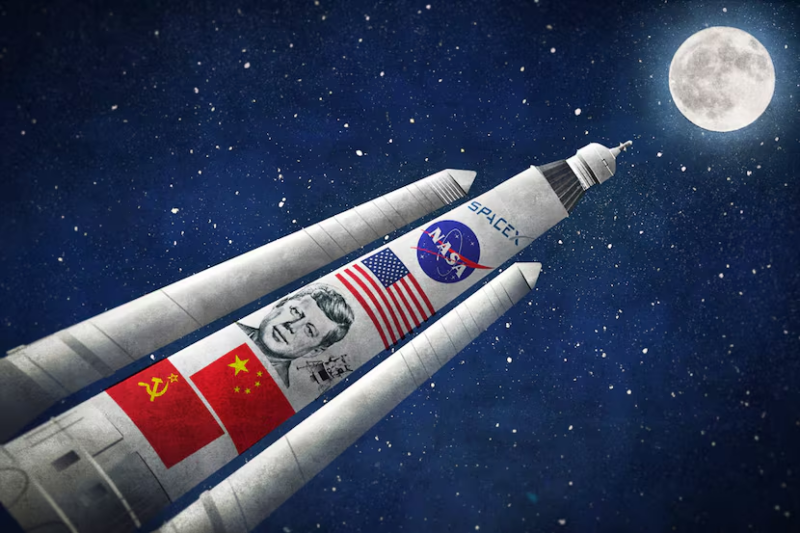
Maybe the most famous answer to the question, “Why go to the moon?” was given by President John F. Kennedy. Addressing a crowd at Rice University in September of 1962, he said that the United States chose to go to the moon because it was hard. It was a statement that made the enterprise seem like an exercise in national self-improvement — a sort of calculus-based calisthenics.
But the White House’s motives for the Apollo program were a little more complicated. We went to the moon in the 60s as a test of scientific and societal superiority. In those days it was capitalism versus communism. Right versus wrong. Good versus evil. Whose citizens were the best educated and the most innovative? Which country’s coffers contained enough cash to finance design and construction of a working moon rocket? Whose astronauts were brave enough to ride a bomb into space? For the U.S., the U.S.S.R., and the ideologically impressionable postcolonial nations of that era, the answers seemed vitally important.
We know who won that contest. On July 20, 1969, Neil Armstrong and Buzz Aldrin became the first human beings to set foot on the lunar surface. So it was settled: The United States of America is the undisputed technological leader of the world. Right?
Well, for 50 years or so, yes.
Now the answer’s not as clear. And maybe that’s why we’re engaged in another race to the moon. We have a different rival this time. China is hardly the monolithic communist country of the 50s and 60s, when praising concepts like profit and science could get a man killed. Today, China produces toaster ovens and electric cars, fighter planes and aircraft carriers. It is currently the world’s No. 2 space power, with serious designs on No. 1. It has sent probes to Mars and the moon. It has its own space station. And it is planning to land astronauts (taikonauts, they call them) on the lunar surface in the year 2030.
This may not seem like a big deal. After all, 12 American astronauts have visited the moon. We’ve been there, done that. Gene Cernan, commander of Apollo 17, became the last man to stand on the lunar surface in 1972. He didn’t just stand there, by the way. He wrote his daughter Tracy’s name in the regolith (i.e., dust) of the moon. Since there’s essentially no atmosphere on the moon, and therefore no wind, humanity’s first space graffiti is presumably still there.
So why race?
Because We Said So
Sean Duffy, NASA’s acting administrator for much of 2025, expressly declared that he’d be “damned” if he let China get to the moon before NASA returned. Once an American official starts saying things like that, it becomes difficult to backtrack.
In the 60s, both American and Soviet bureaucrats carefully waffled about whether there was a race to the moon going on, though everyone knew there was. There’s no waffling from our current administration. We’re in it to win it, though competition for its own sake is probably the least compelling reason for our return.
The Chinese plan is essentially a “plant the flag” effort, with a relatively small lunar lander and modest schedule of lunar activities. America’s effort, as reaffirmed just this week, is more of a “plant a tree” project, with a detailed schedule for establishment of a permanent moon base. The merits of such a program aren’t affected by whether the Chinese land before we do, but it would sure be nice if they didn’t.
Symbolism
There’s a strong element of déjà vu to Space Race 2.0. It’s an eerily familiar battle to demonstrate to the world which system is better — America’s frequently chaotic brand of nearsighted capitalism or China’s more rigid, conformist and incremental approach to social engineering.
The two nations are competing not only here on Earth but above it as well, with space stations, surveillance satellites, space planes and possibly even weaponized satellites proliferating in low Earth orbit. Getting back to the moon first is yet another way of saying, “Look at us! Admire us! Buy from us! Ours is the system that can accept big challenges and figure out how to solve them.”
Practice Makes Perfect
You don’t get to be good at space travel by thinking about it. You get there by going. Living and working on the moon are significant challenges that will occupy some of our best young engineering minds. The effort will teach us lessons and generate hardware and techniques — and possibly spin-offs of useful terrestrial products — that will allow us to stay ahead of the space commerce Joneses.
The Way the Law Works
There’s not much law governing settlement or exploitation of off-Earth real estate. The Outer Space Treaty of 1967 provides that no nation can claim ownership of a piece of any other planet, asteroid or moon. However, the United States, through a multilateral agreement called the Artemis Accords, is attempting to establish that nations can create private “safety zones” for their operations or settlements.
A safety zone doesn’t mean ownership, but it does create control, which is almost as good. And who will end up controlling the best pieces of the lunar landscape? Whichever solar system Sooner gets there first to set up mining operations or install a nuclear reactor, of course.
Water and Fuel
The moon is a more interesting place these days than it seemed to be in 1972. We now think there may be substantial amounts of water in the polar regions, where deep craters hold ice that never thaws. Easily accessible water would make it easier for human beings to survive there.
Some researchers believe we could harvest an isotope called helium-3 from the moon. Helium-3 could be used to power nuclear fusion reactors, as soon as someone manages to create one that actually works.
We know there are lots of other valuable raw materials on the moon as well. The question is how much, and how hard will it be to harvest them. Opinions vary wildly. But we won’t know for sure until we go. This is probably the most compelling immediate reason for resuming exploration of the lunar surface and sub-surface.
On to Mars?
Assuming we find significant amounts of water at the poles, the moon will make a valuable way station, staging point and rehearsal stage for operations on the Red Planet.
Many space enthusiasts believe that for humanity to survive, it needs to become interplanetary. Tying our fate to one planet, even a fantastic one like ours, is a losing bet. A giant asteroid could hit us. Volcanic activity could bring on a new ice age. We could destroy ourselves with nuclear weapons or succumb to some new pathogen. It seems wise to have a Plan B.
Admittedly, the settlement options here in our galactic suburb aren’t ideal, but if we want to find the perfect fixer-upper out there in the cosmos, we need to get started. The moon is our first apartment.
Introduced as America’s ticket to the moon by NASA during the first Trump administration, the Artemis program is years behind schedule and billions of dollars over budget. Indeed, NASA is waiting on important but still unproven hardware from SpaceX (or possibly Blue Origin) before it can even zero in on dates for a lunar landing by the crew of Artemis IV. But those are problems for tomorrow. Today we have a very large rocket and a very cool capsule and astronauts who are more than ready to take another stutter-step for mankind by making this new grand tour.
Will funding a return to the moon be money wisely spent? Or will it turn out to be another mostly empty competition of global superpowers that ought to be working on bigger problems? Time will tell. For now, the race is on. Godspeed Artemis II.
Bruce McCandless is co-author of Star Bound: A Beginner’s Guide to the American Space Program, From Goddard’s Rockets to Goldilocks Planets and Everything in Between.
We welcome your thoughts in a letter to the editor. See the guidelines and submit your letter here.
If you have problems with the form, you can submit via email at letters@dallasnews.com
You must be logged in to post a comment Login