

A Life of Struggle and Service
By John Fullinwider
Special to Texas Metro News
https://texasmetronews.com
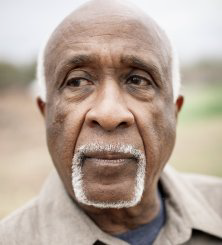
After a lifetime of heroic action in the Civil Rights Movement, Black Power Movement, and related peace and justice struggles, Ernest McMillan came back home in March, to Dallas, from his five-year stay in Albuquerque.
His family found him a house in Casa View, and he settled in, with some peace of mind, after one final struggle with cancer. Ernie joined his ancestors the morning of March 27, the same day that Fahim J. Minkah Community Park was officially dedicated in honor of his old friend and comrade, Fahim, who years ago chaired the Black Panther Party in Dallas.
Ernest McMillan represented the gold standard for what a lifetime peace and justice organizer should be.
His first protest against injustice was in Dallas, when he joined the picket line against “Negro Appreciation Day” at the State Fair of Texas, the only day that Black people could attend the Fair. He was 9 years old.
The summer of 1963 after graduating from high school, Ernest moved to Georgia to stay with his father before starting college. But he was sent home after local police in Newnan threatened his father, claiming he was “stirring up trouble” by organizing people to support the March on Washington set for that August.
Arriving at Morehouse College for the Fall 1963 semester, Ernest mainly spent his time at the 24-hour demonstrations at Pickrick Cafeteria, a segregated restaurant owned by Lester Maddox, later elected Georgia Governor in 1966 on a segregationist platform.
He joined the Student Non-Violent Coordinating Committee (SNCC) in 1964, becoming a field officer in Thomas County GA, working on registering voters, electing Black candidates, and supporting the local meatpackers efforts to desegregate the company and organize a union.
These difficult and at times dangerous experiences led Ernest back to Dallas to organize the city’s SNCC chapter, serving as its Chairman from 1967-1969. He worked on a wide range of issues including youth organizing, welfare rights, police brutality, food deserts in Black neighborhoods, student protests at UTA over their Confederate icons, and other issues that resonate to this day.
Ernest was probably Dallas’s most famous draft resister during the Viet Nam War.
In Dallas in 1981 he founded People United for Justice for Prisoners to create support systems for formerly incarcerated people.
In Houston during the 1980s, Ernest opened the first Drug Prevention Program there for Black youth. In 1984, he founded the Fifth Ward Enrichment Program, a non-profit, community-based development initiative focused on Black and Latino youth; he directed the program for twenty years.
In Dallas during the years 2002 – 2021, he worked with Dallas Peace Center, Pastors for Peace, Witness for Peace, Youth Believing in Change, and most recently with Cara Mia Theatre as its Curator for Community Action.
I have often asked myself why Ernie and Fahim, why SNCC and the Black Panthers continue to inspire people today more than six decades after they emerged in Dallas and Oakland – and in cities across the nation. I think it’s because their courage and vision ran deeper than the battle of the moment.
They would take the hard won reform or program (breakfast for children, sickle cell initiative, a hundred voters registered in a small town of the Deep South), always good to celebrate a victory. But beyond any reform within the unjust system, they never lost sight of the necessary transformation of the system itself.
This is why they were proud to claim, as Fred Hampton famously did, “I am a revolutionary.”
We have lost many a warrior in the long years since Ernest McMillan set out to change Dallas. The wide range, the staying power, and the deep humanity of his words and actions remain.
You can learn more about Ernest McMillan from his books: Standing: One Man’s Odyssey Through the Turbulent ‘60s and Kneeling: Poems and Verses Transcending the Turbulent ‘60s. Both are available from Deep Vellum Press: https://www.deepvellum. org/authors/m-ernest-mcmillan/.
Biographical details are taken from the Civil Rights Movement Archive: https://www.crmvet.org/.
John Fullinwider is a longtime community educator and organizers in Dallas.







You must be logged in to post a comment Login