

By Alexis Larue and Jamannie Morgan
Afro
https://afro.com/
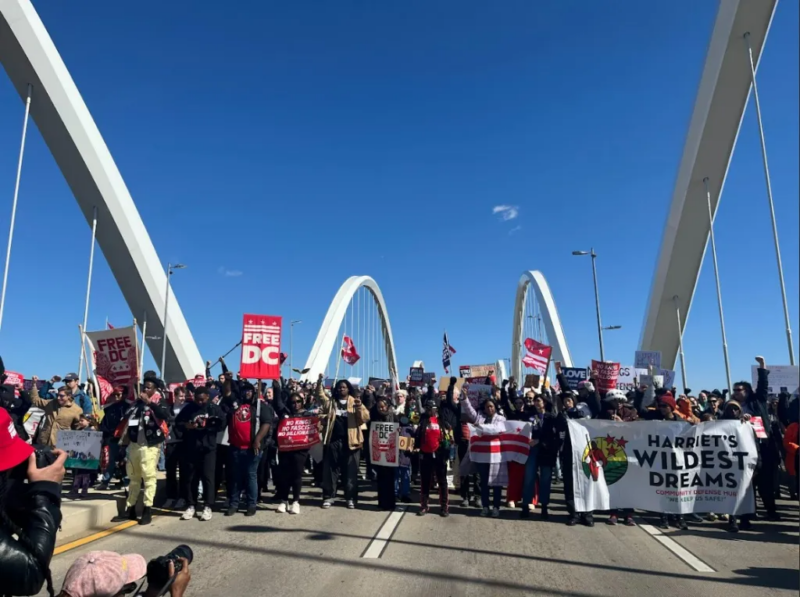
Demonstrators gathered in Baltimore and Washington, D.C., on March 28 for the “No Kings” protest, a coordinated effort opposing what participants described as threats to democracy, civil rights and economic stability under the current national leadership.
In Baltimore, residents of varying ages gathered from noon to 2 p.m at the intersection of York Road and Gittings Ave. with a shared message: resistance against authoritarianism and a call to protect democratic institutions. The protest extended along the strip towards Towson Town Center.
Jonathan Wilson, an associate professor of biology at Morgan State University, said he felt compelled to attend rather than remain on the sidelines.

“Democracy is being eroded everywhere. I’m not going to sit on the sideline and not do anything. This is a democracy where we don’t have a king,” Wilson said.
The 77-year-old said he was also concerned about rising prices and general economic instability.
“When I used to go to the grocery store I used to spend $50 and get a lot. Not anymore, everything is going up,” he said.
George M. Van Hook Sr., a 72-year-old retired public administrator, connected those rising costs to broader political decisions and White House and congressional leadership.

“When I drove here, I had to pay more money for gas,” Van Hook said. “Why am I paying more? Because of decisions being made at the federal level.”
Beyond economic concerns, Van Hook framed the protest within a longer historical struggle for civil rights.
As someone who grew up during the height of the Civil Rights Movement in the 1950s and ‘60s, he said the current political climate feels like a reversal of hard-fought progress.
“We are moving backwards and it is unacceptable,” he said. “Each generation has to stand up for freedom and democracy.”
When asked what changes he would like to see as a result of these protests, Van Hook mentioned more interest in local elections and less tyrannical dictatorship.
“When people organize, I believe that they are encouraged to vote, they are encouraged to run for office, they are encouraged to contribute to causes that make a difference. And so much of the advantage here is sending a message to the society that we are not in favor of the kind of misleadership that we right now see,” Van Hook said.

Joe Nobles, a 77-year-old Baltimore native, voiced frustrations with the direction of the country and described the protest as a fight to protect basic freedoms.
“First and foremost, freedom,” he said of his reasons for participating. “They’re trying to take all of our freedom away from us.”
While some participants pointed to immediate economic strain, others emphasized looming policy changes and long-term consequences, such as the undermining of voting rights and other rights that were likely targeted in Project 2025.
“The only thing that we can do is get out here and protest to make progress in the right direction,” Nobles said.
The protest is part of a broader national movement – whose tentacles have spread abroad with No Kings protests in several European countries on March 28. A parallel demonstration took place in Washington, D.C., where additional voices and organizers echoed similar concerns.

Between 1:30 p.m. and 4 p.m., a diverse crowd of 125,000 individuals marched through the streets of the nation’s capital. They processed across the Fredrick Douglass bridge, sharing songs and dances, united by chants to “take D.C. back” from those in power.
Protesters also used chalk to write messages on the streets outside of the building where Department of Homeland Security advisor Stephen Miller works, criticizing his role in implementing policies that restrict the rights of immigrants.
Spectator Mia Washington offered her perspective on the protest and the significance of witnessing others exercise their right to voice their concerns.
“When people protest, it shows that we stick together,” said Washington. “When we stick together, it really speaks of value. So I’ll definitely show up to the next protest.”

There were not only older individuals protesting, but also a younger generation of those who wanted to see a change for their potential future.
Na’im Faulkner, a sophomore at Howard University, talked about his time as a first-time protester and what it means for people to organize a protest such as the No Kings protest.
“When people organize, that’s how we win,” said Faulkner. “As long as we can build more power together as a people, then there’s always hope.”
Black demonstrators said the issues at the center of the protest carry particular urgency for their communities, especially when it comes to voting rights, economic inequality, immigration and access to resources. They said it is clear that despite his claims to the contrary while on the campaign trail, Donald Trump does not want the best for Black, Brown and indigent communities.
“The person that we have in office is so unpresidential and he’s only working for different sections of this country,” said Craig Davenport, a participant of last year’s No Kings rally in D.C. “He’s marginalizing communities and he’s not for everyone.”


You must be logged in to post a comment Login