
From Texas to Virginia, the GOP is expanding efforts to curtail the power of prosecutors in Democratic-leaning cities.
By Jamiles Lartey
The Marshall Project
https://www.themarshallproject.org/

This is The Marshall Project’s Closing Argument newsletter, a weekly deep dive into a key criminal justice issue. Want this delivered to your inbox? Sign up for future newsletters.
Ever since the Supreme Court’s decision last month in Louisiana v. Callais further weakened the Voting Rights Act, national headlines have focused on a renewed Republican push to redraw congressional maps across the South and dilute the voting power of Black and Democratic voters in major cities. But another fight over urban political power has been unfolding more quietly: who gets the authority to prosecute crimes in some southern states.
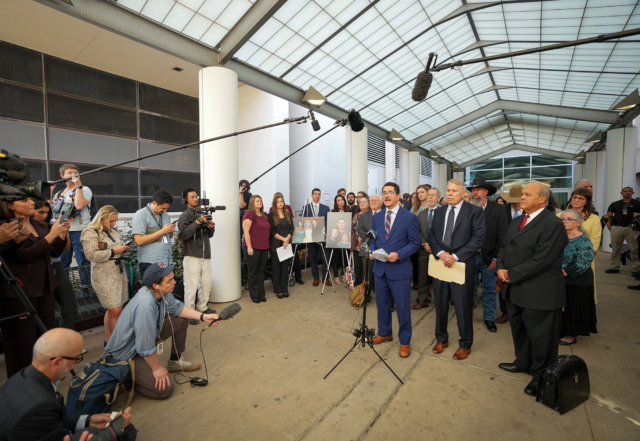
In Texas last week, Gov. Greg Abbott announced a package of criminal justice proposals, including a bill to create a new, unelected statewide prosecutor’s office that could bring charges when local district attorneys decline or fail to do so. While the office would theoretically have jurisdiction over the entire state, Abbott’s pitch has centered heavily on one target: Travis County D.A. Jose Garza, the Austin-area Democrat whom Texas conservatives have spent years casting as “soft on crime.”
Garza is often described as a progressive or reform-minded prosecutor, loose labels generally applied to district attorneys who argue that public safety does not always mean seeking the harshest possible punishment. Many have run on promises to reduce the harms of mass incarceration, limit prosecution of low-level offenses, expand diversion programs, or declining to enforce laws they view as unjust, including abortion bans.
Since the first wave of reform prosecutors began winning office in the 2010s, opponents have tried to restrain their power through recalls, suspension, impeachment efforts, and various forms of state oversight. Texas Republicans have already tried one route for reining in prosecutors like Garza. In 2023, Abbott signed a law allowing D.A.s to be removed from office for refusing to prosecute certain categories of crimes. A county resident later used that law to seek Garza’s removal, but the case was ultimately dropped by the outside prosecutor assigned to the case.
Abbott said at a press event that his latest push was largely based on Garza’s office having failed to file indictments by the state’s 90-day deadline in over 200 cases in 2024, leading to the releases of some people accused of violent crimes. Garza acknowledged that his office had previously missed deadlines, but in 2025 said his office was no longer failing to file indictments, and last week called the governor’s proposal a “political stunt.”
Abbott may not be done trying to get Garza out of office either. Another piece of the governor’s proposed legislation would make D.A.s eligible for impeachment. That’s a bigger legislative lift, however, as it would require an amendment to the state Constitution.
Abbott’s proposals represent a kind of blunt instrument: Remove local prosecutors, or create a state official who can override them. In Georgia, Gov. Brian Kemp signed a bill on May 12 that takes a subtler approach. HB 369 changes the election rules for district attorneys and other local officials in a small group of metropolitan Atlanta counties — a move that critics say is aimed at weakening Black political power in the heart of the state’s Democratic base.
The new law purports to make prosecutor elections non-partisan — meaning that all candidates would run in one primary and without party designations on the ballot — and only applies to “consolidated law enforcement counties” where the office of the county coroner has been abolished. This means it affects prosecutors in just five of Georgia’s 159 counties.
If you’re wondering what the absence of a county coroner has to do with prosecutor elections, you’re not alone. Fair and Just Prosecution, an advocacy group that represents reform-minded D.A.s, said in a statement, “There is no clear connection between the absence of a county coroner’s office and whether prosecutor elections should be partisan or nonpartisan.”
Critics see the move as a thinly veiled effort to boost Republican chances in Democratic stronghold districts. “This is a blatant attempt by Republicans to give their candidates an edge in Democratic counties by hiding their party affiliations from voters,” Sherry Boston and Fani Willis, two of the D.A.s in the affected counties, said in a joint statement earlier this month.
The change would also have a disproportionate effect on Black Georgia residents. The five counties are home to roughly 45% of the state’s Black population. Boston and Willis have said they plan to challenge the change in court.
You must be logged in to post a comment Login