

A gas line was reportedly struck near an Oak Cliff apartment and may have leaked into the building, causing an explosion.
By: Niamh Ordner,Staff Writer
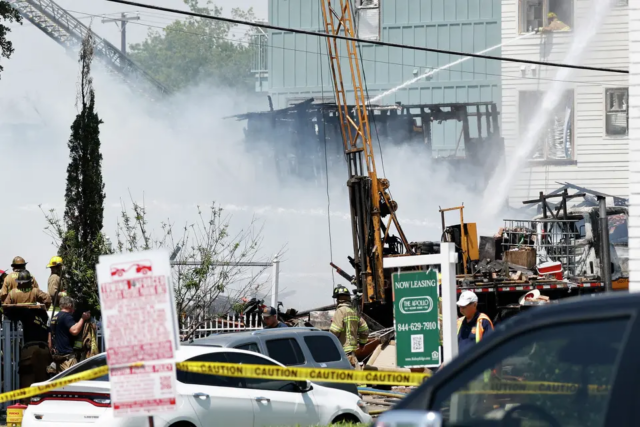
In the early afternoon of Thursday, May 28, fire rescue crews responded to a 911 call reporting a gas leak at The Clyde apartments in the 400 block of East 9th Street, near Patton Avenue, when the building exploded and burst into flames.
Three people have been reported dead, including one child, and at least 5 others were injured.
The blaze was soon classified as a five-alarm fire, the most severe category used by Dallas dispatch, indicating a large-scale emergency that requires an extensive response.
According to Geoff Henley, a Dallas attorney representing the property owner, a contractor was drilling into the ground when they struck a gas line. This was later confirmed by Atmos Energy, which received a report at 12:51 p.m. Thursday that a construction crew had damaged a natural gas pipeline near 409 E. 9th Street.
Third-party gas-line strikes are the No. 1 threat to underground infrastructure, said Abe Scarr, the energy and utilities program director at Public Interest Research Group.
How do gas leaks cause explosions?
When pressurized gas lines are ruptured, natural gas — which is primarily composed of highly flammable methane — rapidly leaks into the surrounding soil and adjacent air spaces.
Methane is about half the density of air, making it significantly lighter and causing it to naturally rise. When natural gas leaks occur underground, however, methane has nowhere to go.
“The gas will flow where it can,” Scarr said. “If it’s not bound up by the pipe, it will escape and get into the air.”
The gas can travel through air spaces in soil, gravel, the area around the gas pipe, or sometimes utility tunnels or conduits leading to buildings, where it then accumulates.
Once the methane concentration in the air reaches the explosive range, between roughly 5% and 15%, a small spark from a light switch, a stove igniter or even static electricity can trigger an explosion.
The exact cause of the Oak Cliff fire is still unknown. The National Transportation Safety Board has sent investigators to Dallas, and more information will be released as the investigation unfolds.
“It is possible that, after the gas line was hit, the gas migrated underground and into the apartment building, where it then reached explosive levels before igniting,” said Kenneth Clarkson, communications director at Pipelines Safety Trust. “It is also possible that the gas was ignited above ground as well.”
Images of the scene show a utility truck that was partially destroyed by the fire. However, there are no records of active construction permits for the site, so it is unclear who was doing work or who can be held responsible.
There have been other notable incidents along gas lines owned by Atmos Energy, Clarkson said. For example, In February 2018, 12-year-old Linda “Michellita” Rogers was killed by an explosion due to an undetected gas leak from an Atmos Energy pipeline while getting ready for school in her northwest Dallas home.
Niamh Ordner is a science reporting fellow at The Dallas Morning News. Her fellowship is supported by the University of Texas at Dallas. The News makes all editorial decisions.
Science and Medicine Fellow
Niamh Ordner is a science and medicine fellow at The Dallas Morning News and a 2025 AAAS Mass Media Fellow. She has covered scientific research, environmental policy and public health for publications including the Los Angeles Times and Smithsonian Magazine. She graduated from Rice University in 2026 with a degree in biosciences.


You must be logged in to post a comment Login