
By Anthony Council
Correspondent
Texas Metro News

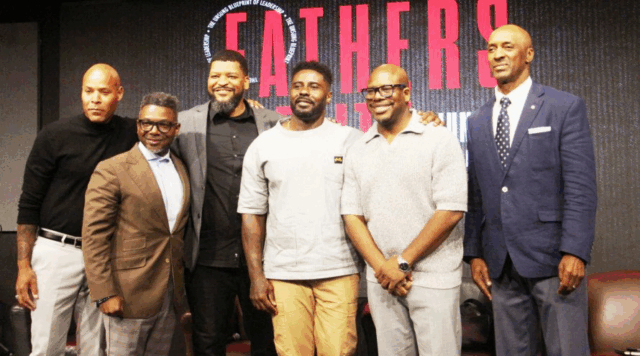
Laterras R. Whitfield, Founder, Dear Future Wifey; Byron Williams, NFL alumnus, President, DFW Chapter.
Photo credit: Anthony Council, Texas Metro News
It was a day of encouragement, laughter, and honest conversation at Garland North Baptist Church during the Fathers and Faith Brunch. Dozens of men came together not just to enjoy a good meal, but to reflect on what it truly means to be a father in today’s world.
The event, led by Head Pastor Dr. Tony Mathews, provided a safe space for men to explore the challenges and blessings of fatherhood through the lens of faith. Attendees engaged in thoughtful discussions about how past experiences continue to shape their roles as fathers today.
Before the panel discussion, comedian Shedrick Garrett set a lighthearted tone, sharing humorous stories about his spiritual journey, joking about giving his life to Christ back in 1999, and announcing his plans to recommit this year. Garrett also excited the crowd by revealing his upcoming role in the Madea movie, Madea’s Destination.
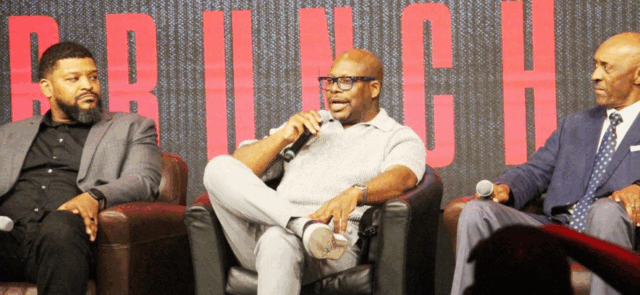
The panel featured an impressive lineup of voices, each bringing a unique perspective on fatherhood and personal growth. Donte Dean, Vice President of Development at A Chance to Learn; Dr. Anthony D. Coleman, President of COGIC Urban Initiatives; Chris Davis, Founder and CEO of Dads Forward; Laterras R. Whitfield, Founder of Dear Future Wifey; and Byron Williams, former NFL player and President of the DFW Chapter, shared insights on healing, mental health, faith, and leadership.
Dr. Barnett led the panel with a breathing exercise for everyone to do and asked them not to reflect on their life but just on the past week.
Asking the critical question of what moments you could have stood still and become more involved in the moment at that moment. With each breath the men took before the discussion, the tenseness left the room like a weight taken off their shoulders.
Dr. Barnett led the panel with a breathing exercise for everyone to do and asked them not to reflect on their life, but just on the past week, asking the critical question: What moments could you have stood still and become more fully engaged in the moment? With each breath the men took before the discussion, the tenseness left the room like a weight taken off their shoulders.
The panel discussion wasn’t the only highlight of the event. It also gave men an opportunity to engage in community moments, such as prize giveaways, including recognizing the father with the most children.
One of the recipients was Fabian Speed, a father of seven, who shared a deeply personal story.
Sitting next to his 25-year-old son Tariq Speed, Mr. Speed revealed the pain of losing one of his children.

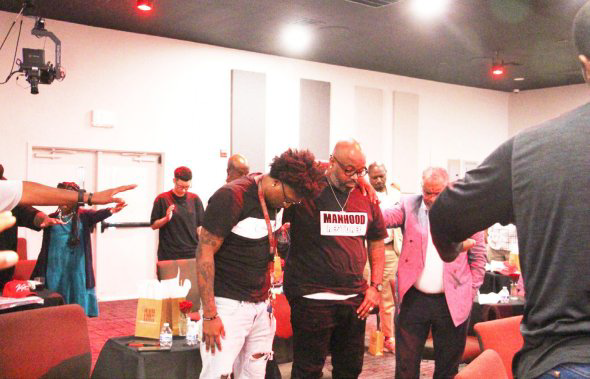
His vulnerability created a sacred pause in the room. Dr. Jay Barnett gently challenged him to truly mourn. The discussion was genuine and honest, beginning with the powerful question: “What’s one thing you wish your father knew?”
For Chris Davis and his father, it was a matter of emotional intelligence, without hesitation.
“Emotional regulation,” he started. “You know, we were former ball players, man, so football was my therapy, and so I didn’t know how to process through my emotions. So emotional intelligence and how to navigate as a young man would have been paramount.”
For Laterras Whitfield, he wished his father knew how deeply he didn’t want to be like him. Reflecting on that relationship, he shared a powerful sentiment: “I forgive you for not living up to my expectations. And I forgive myself for being a part of you that I never wanted to become.”
In a recent interview, we discussed fatherhood, masculinity, and the conversations men should be having with themselves and with each other.
What did Father’s Day mean for you this year?
Laterras: “Father’s Day this year means legacy for me. I kept hearing the word legacy internally; it’s all about legacy. I’ve learned a lot about being a father, especially through doing the Dear Future Wifey podcast.”
What does being a father mean to you, and how has doing the Dear Future Wifey podcast shaped that?
“What I’ve learned is how much I didn’t know. I’m 47 years old, I’ve seen it all, you’ve heard it all. But the more I talked to other people, talked to my kids, my kids showed me the deficiencies I had in myself: a lack of patience, a lack of understanding of this new generation.
I found myself, like I said on that panel, saying things like, ‘When I was young… I would never… when I was your age…’ That type of stuff. We didn’t have cell phones—I didn’t have a cell phone. We had beepers.
So I had to realize that while some of the things I did as a teenager—like work ethic—can still be applicable, the things they face right now are something I can’t relate to. If I turn my ear toward their mouth in order to listen to what they’re saying, then I can learn how to best meet the needs of my children.
What I’ve learned with this podcast is similar. I created this podcast to become a better listener. I was always the type that, when my lover was talking, I would always jump in. I would want to finish the sentence to get my point across.
On my podcast, I would force myself to listen, no matter how long the person talks. So my podcast has taught me to become a better listener.”

What does being a man mean to you?
“Manhood is responsibility. We always hear about being a provider. Manhood is about being a provider. We always relegate that to financial provision.
When I look at manhood done properly, we want the comprehensive man where he’s not just the provider financially, but he’s the provider emotionally, spiritually, and psychologically.
That’s some of the things that men don’t teach each other. Men don’t teach each other. Men don’t teach each other about emotional intelligence. It’s always, “Get a job, make sure you take care of your family, that’s it.”So, what we grew up with is emotionally unavailable fathers. The only time they would tell you “great job” is most of the time when you’re running a football, playing a sport, and you’ve won the game.
Most of the time, when I talk to people that were athletes, their parents would tell them about the loss.
You know, especially men saying, “Why did you miss that tackle? Why did you do this? Why did you do that?”
Instead of saying, “You know what, man, you gave it your all. I’m proud of you, son.”
They be like, “Ain’t nobody carrying my last name going to be sorry.” he stated “They just start telling the kid that all his efforts suck, that he’s terrible, that he’s always going to be terrible unless he changes his life instead of congratulating him and going out there on the field.
That’s where we get toxic masculinity in a lot of young men, where we get that performance mentality that we have to perform in order to be valued.”
So I wish that men understood that manhood is failure. That you’re going to fail, you’re going to make mistakes, and you’re still a man, you’re going to make bad decisions.
That manhood to me is the constant mindset of overcoming to keep trying, no matter how bad it is in your marriage, keep trying, no matter how hard marriage is. Special manhood is the responsibility and the heart posture to not give up.
As he stated, it’s also about celebrating wins as well.
“Men end up dying early with stress and heart attack because we keep trying and trying and trying to get more, more, more.
When it’s like, man, stop, you did great. You graduated from high school, give yourself a pat on the back. You graduated from college, give yourself a pat on the back. You got your license and employment, whatever it is, stop and pat yourself on the back instead of saying, “I’ve got to do more to find value.”
What can you tell the fathers about your experience of being a father?
“Give yourself grace. Give yourself grace and forgive yourself. Apologize to your kids for whatever went wrong, whether it’s with their mom, not being present in their life, or whatever your story is.
Give yourself grace, forgive yourself, and verbalize that to your kids. Let them know that you were at least aware of what you did or didn’t do. Do that first. Then give yourself a pat on the back for still being committed to fatherhood.
There are people that are not present at all. They feel like their child is better off without them. I’ve heard men say that, and I’m like, what?! How did you make that decision? Let that kid make that decision. That kid is physically abandoned, and you didn’t even give them the time to say, “I cared about you.” Let that kid make that decision. But show up, be present, and be thankful — a lot of people are struggling to produce kids. That kid is a miracle, and what you participated in is a miracle, a miracle child.”
Some exciting news was revealed as his daughter is about to have a baby girl, and Mr. Latreaus is about to be a grandfather. We got to have a sneak peek into his new world of being a grandfather soon.
What does it mean to be a grandfather soon?
“To be a grandfather, I have no idea. I’m just looking forward to it and to have fun. I just know I don’t have a lot of responsibility. I’m looking forward to it, knowing that I don’t have to carry the weight, just show up and have fun. I want to give my daughter and son-in-law grace to make mistakes. Not to come in and try to manage their parenthood. Let them make mistakes, let them bump their heads. I just want to be a place of wisdom and advice when asked and requested.
Make sure my nephew is the best equipped to be prepared for life. You know, my parents never prepared me for life at all. I mean, when I say never had a talk about what to expect, how to budget, how to spend money, how to get a job, how to drive a car, I had to learn on my own. I mean, literally learn on my own, and I had to bump my head a lot, but that gave me the fortitude to be able to do what I do. But I want to best equip my nephew, my son, with the tools in order to succeed.”
In a world that often measures men by what they do instead of who they are, the Fathers & Faith Brunch reminded many men that fatherhood is not about perfection, but about presence. It’s about showing up, speaking truth, offering grace, and being willing to grow.
As these men lifted their hands in prayer, shared tears, and told their truths, a more profound message echoed: Healing begins when men are safe enough to be human. The legacy of fatherhood isn’t written in titles or trophies, but in moments of honesty, compassion, and commitment to doing better.
These men weren’t just sharing experiences; they were rewriting the narrative of what it means to be a father, a man, and a leader. And if this brunch proved anything, it’s that faith and fatherhood are not just pillars of strength, they are the foundation of generational change.
Anthony Council is a recent graduate of the University of North Texas And a member of the National Association of Black Journalists.
You must be logged in to post a comment Login