By Rita Cook

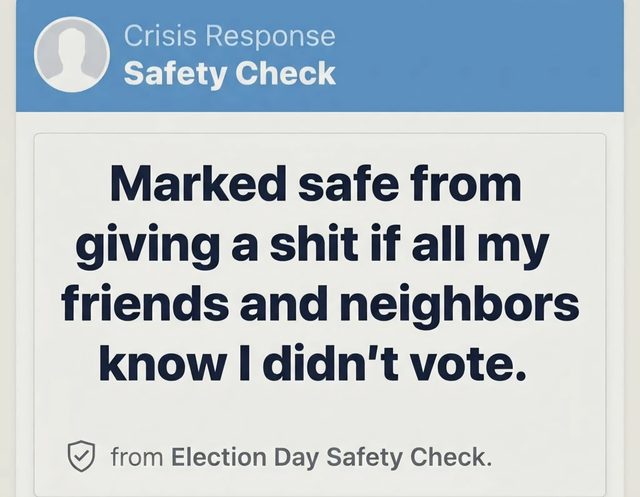
WASHINGTON D.C. – During major emergencies like hurricanes, tornadoes, or earthquakes, Facebook allows users to quickly mark themselves “safe.” So, a few days ago, I couldn’t help but laugh when someone put a satirical spin on it, posting a notification that they had successfully marked themselves “safe from giving a shit if all my friends and neighbors know I didn’t vote.”
I am going to leave that right there, but I just had another belly laugh writing that last sentence.
When I got that piece of mail telling me that all my friends and neighbors would know I did not vote, I thought it was a joke.
But no, it was not a joke. It was just one more creepy way that the political game has figured out how to seep into the psyche to shame people.
Spoiler alert: I might not have voted if I had received this stupidity in the mail before I had actually voted on the second day of early voting.
Since it informed me that while my neighbors would not know who I voted for, they would just know if I voted I thought surely my neighbors are not that pathetic or I am in the wrong neighborhood.
I did a little more research on this commercial and I discovered it is known to be an intentional campaign tactic known as a “social pressure” or “shame” ad.
For the record, it is not a federal or state government campaign.
These ads are funded and distributed by independent political action committees (PACs), political parties, and special interest groups from both sides of the aisle.
Does this manipulation ever end?
This is why people I know are sitting out the November elections. It is the same stink, just a different animal.
Credit where it is due: political science researchers Alan Gerber, Donald Green, and Christopher Larimer pioneered the use of shame and peer pressure to boost voter turnout in a landmark 2008 study.
I was surprised to find that this tactic has been around this long.
As mentioned above non-profit and super PAC voting groups use it and my research pointed to groups like the Center for Voter Information and the Voter Participation Center. They reportedly send out “Voter Report Cards” telling residents they will share who does and does not vote with their local neighborhood (like the mailer I received). Progressive groups like VoteVets have similarly used ads warning voters that their communities will see their post-election participation charts.
Major political parties from both sides have also deployed these tactics. In Texas, official campaigns have even built customized mobile platforms. These platforms cross-reference a user’s phone contact list directly with public state voter rolls so individuals can track and confront friends, family, or neighbors who have not voted yet.
There are also targeted social media ads (on platforms like Instagram, TikTok, and Facebook) being pushed by groups such as “didthey.vote,” which uses influencer sponsorships to turn public voter logs into a social tracking tool. Note to candidates and those involved in this ridiculous tactic, we see you and if you need to manipulate you DO NOT need to win.
Rita Cook is a world traveler and writer/editor who specializes in writing on travel, auto, crime and politics. A correspondent for Texas Metro News, she has published 11 books and has also produced low-budget films.




You must be logged in to post a comment Login