

The Florida state representative and bookstore owner is challenging Republican Sen. Ashley Moody with a people-powered campaign focused on health care, political corruption and representation.
By Shelby Stewart
Essence
https://www.essence.com/
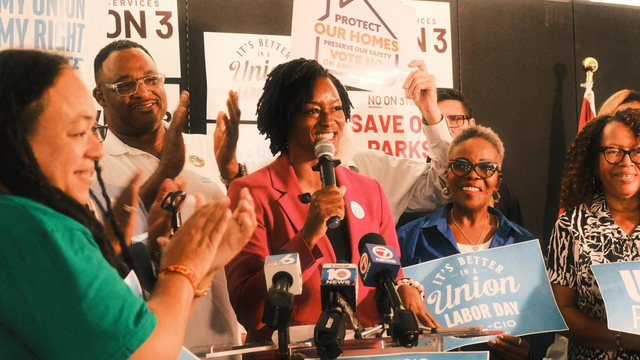
Angie Nixon says she didn’t really choose to run for the U.S. Senate. “The people decided for me actually,” the Florida state representative said in an interview with ESSENCE, describing a statewide listening tour in which, she says, voters requested that she go to Washington.
Now the Democratic nominee, Nixon, 42, faces Republican Sen. Ashley Moody in the Nov. 3 general election, just 19 days away. She has served in the Florida House since 2020 and is a member of the Democratic Socialists of America. Back in August, she won the Democratic primary with 56.1 percent of the vote to Alex Vindman’s 43.9 percent, a result that surprised much of Florida’s political machine. Vindman, a retired Army lieutenant colonel and former national security official, had reported raising $16.7 million by mid-year. Nixon however, had reported a little over $625,000.
How a candidate with that kind of gap in funding won, Nixon says, comes down to who she is listening to. She argues that Washington listens to “the lobbyists of these big corporations, the lobbyists of these billionaires,” while Florida’s working families, and Black women in particular, are paying the price.
Her answer, she said, is to build policy from the ground up, that surpasses political and party lines. According to the Independent Voter Project, the Sunshine state is majority republican with nearly six million registered voters. Just 31 percent of the state are registered democrats and the last of the population is registered as independent or other.
Nonetheless, Nixon described advisory committees of “just regular everyday working people” who help her craft legislation and decide which bills in committee or on the floor help or harm their local communities, alongside town halls and listening sessions. “Washington is just not going out talking to working people as much as they should,” she critiques. The voters she met on her tour wanted someone with “a backbone that’s going to do more than send strongly worded emails” and who would “weed out the corruption and chaos.”
Her campaign slogan is “People-Powered,” and she has said Florida should work for everyone, not only the “rich and well-connected.” She used the interview to recruit, too. “I need some of them to make sure that they’re on my advisory committee,” she said of Florida’s working families.
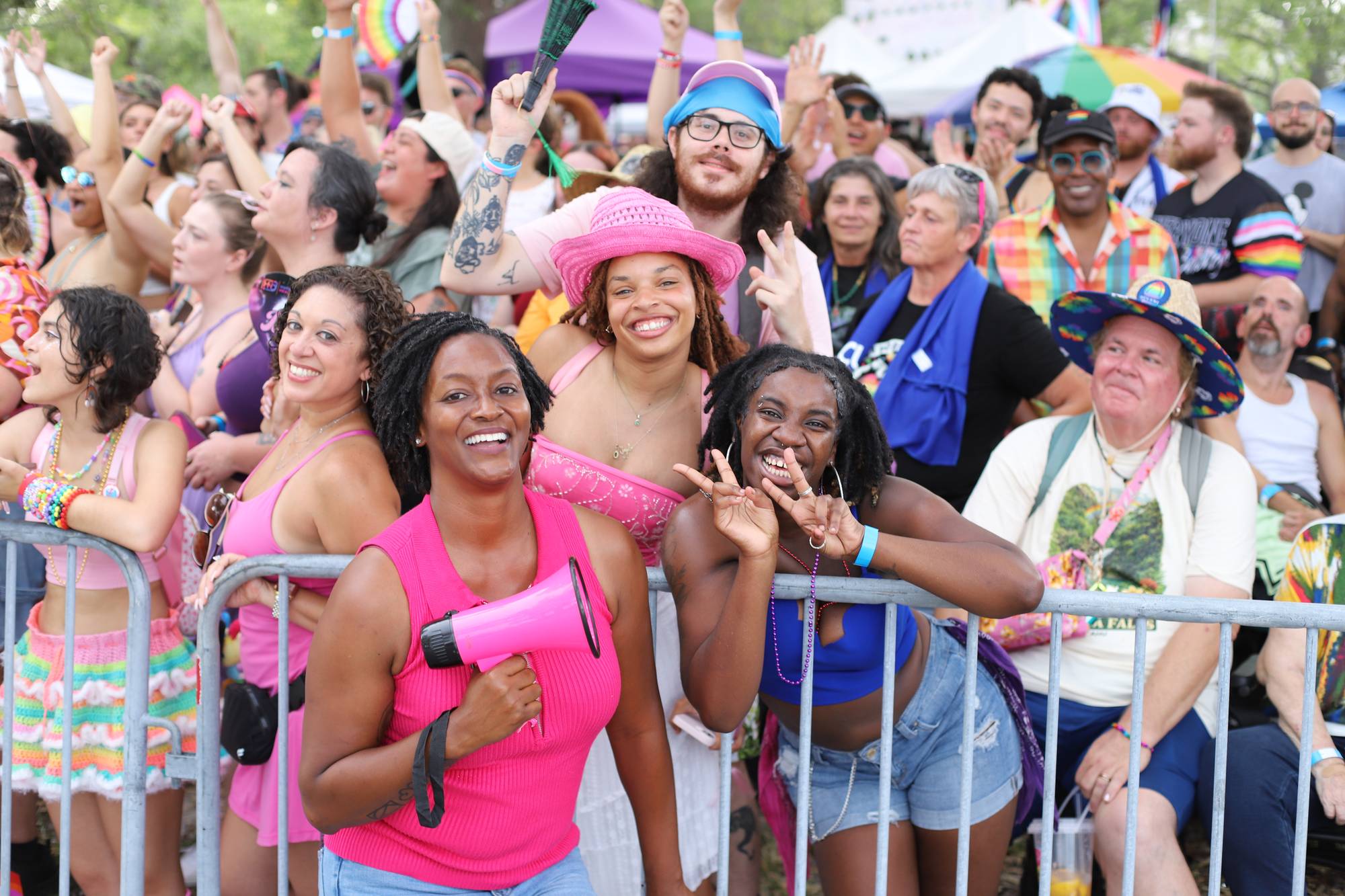
Nixon’s willingness to put her body behind that message was on public display this spring, when a fight over Florida’s congressional map made her a household name. The map, drawn in Gov. Ron DeSantis’ office and passed during an April special session, could shift Florida’s delegation from 20 Republicans and 8 Democrats to as many as 24-4. On April 29, as the House voted on the bill (HB 1D), Nixon paced the chamber floor with a pink bullhorn, shouting that the map was illegal. The House Rules and Ethics Committee formally reprimanded her on May 14.
The reprimand did not slow her down. The next day, May 15, Nixon staged a roughly five-hour sit-in outside DeSantis’ office demanding a meeting and a new special session, and Capitol Police arrested her that evening. She was charged with trespassing and resisting an officer without violence. She later settled the case with a $250 fine and 15 hours of community service, though she says she did not plead guilty and did nothing wrong. DeSantis called the sit-in “performative nonsense.”
Nixon pointed to a Black colleague in the chamber who is among the House’s senior members when it came to being willing to risk her freedom. She said she remembered what that lawmaker had said about growing up during the civil rights era, when she marched with her parents for the right to vote. “I couldn’t just sit idly by knowing that this woman had gone through all of that and I’m witnessing our rights being eroded,” Nixon said. She described the goal of the new maps as letting “politicians can decide their voters instead of allowing people to decide who would represent them.” Then she drew the line she says guided her: “And so if people were able to risk their lives for our rights, I can risk being jailed for a misdemeanor for ours.”
So far, the courts have sided with the governor. A Tallahassee circuit judge declined to block the map in late May, and the Florida Supreme Court declined on June 10 to stop it from being used in 2026. Challengers argue it violates the state’s 2010 Fair Districts Amendment, which bans maps drawn to favor a party, while DeSantis’ lawyers say the old map’s race-conscious districts, such as South Florida’s District 20, became unconstitutional after the U.S. Supreme Court’s ruling in a Louisiana voting rights case.
This was not Nixon’s first protest over a map. During the 2022 redistricting session she and two other Democrats sat on the House floor chanting “Stop the Black attack,” after lawmakers approved a plan that eliminated two districts held by Black members of Congress.
The history is personal for her. “I am unapologetically Black,” she said. She pointed to maternal health, pay equity and the racial wealth gap, and said Black entrepreneurs often start businesses “out of desperation and need because folks don’t necessarily want to hire us or pay us living wages.” Black women, she said, are “four times more likely to die due to childbirth than white women.” Federal data supports the disparity: the CDC reported that Black women died around the time of childbirth at a rate nearly 3.5 times that of white women in 2023, up from about 2.6 times in 2021 and 2022.
“My lived experience as a Black woman definitely shapes the way in which I legislate,” Nixon said, adding that she writes policies to help marginalized people, “particularly Black people, but knowing that it’ll help all people as well.”
She has carried that out of the Capitol and into a storefront on Soutel Drive in Northwest Jacksonville. Café Resistance, a bookstore, coffee shop and community hub that opened in 2024, stocks titles by Black authors and books challenged or removed from Florida schools. Nixon opened it in response to the state’s school book restrictions, including a 2022 law, House Bill 1467, that DeSantis signed, and it operates through the nonprofit Moxie Group, where she is executive director.
“My bookstore is not just a bookstore though, it’s a third space,” she said, describing free tutoring, mentorship programs, mental health workshops, occasional health clinic pop-ups, mutual aid and free Plan B. “It is a power building space where groups are educating people about how to build power within their communities and hold lawmakers accountable.”
Books matter politically, she argued, because history shapes identity. “If you don’t teach history, you’re doomed to repeat it,” she said. Erasing a people’s history leaves them feeling “without a home,” she said, especially descendants of enslaved people. “They want us wandering aimlessly, and that is something that I refuse to allow to happen.”
The store has not escaped criticism. The conservative Washington Free Beacon reported on a wall displaying Black power-era figures, including some convicted of violent crimes, and Nixon defended it at an event there, saying visitors should know “their true and accurate history.” Her stance, she said: “I stand by everything in this bookstore.”
If books are one front in her argument about power, money is another. Nixon called for overturning Citizens United, the 2010 Supreme Court decision that opened the door to unlimited independent political spending by corporations and unions. “We need to get big money out of politics, period,” she said. She would ban PACs, let people give only directly to candidates’ committees, and cap donations at $1,000.
“That would allow more working families to be able to run for office,” she said. She says her own average donation is less than $30, which means “the only people that I’m beholden to and will ever be beholden to are just regular everyday people.” The gap in this race has been wide: reports by the New York Times, relayed by NewsOne, said Nixon raised roughly $975,000 through the primary and spent about $60,000 on advertising, a fraction of Vindman’s total.
But when asked which single issue the Senate should tackle first, Nixon turned from money to something more immediate: healthcare, which she called “a leading cause of bankruptcy.” She told a story about her own daughter, who was having severe migraines and considered calling an ambulance. “I’m like, ‘No, no, no, no. Wait, wait, wait. Let me just Uber you there,’” Nixon recalled, because a rescue ride could cost “$250, $500.” Her day-one priority would be extending the enhanced Affordable Care Act subsidies that expired at the end of 2025. She said Moody voted against extending them, a vote the Florida Democratic Party also highlighted after the Senate rejected a three-year extension in December 2025. The party said Moody and Sen. Rick Scott were among those voting no.
The numbers show a significant loss of coverage. Federal figures show Florida had about 261,000 fewer marketplace sign-ups this year, and a later analysis of KFF effectuated-enrollment data found Florida’s paid ACA enrollment fell about 10%, from 4.3 million to 3.85 million, a drop of roughly 450,000. Nationally, about 2.7 million people left the exchanges. Florida, which has not expanded Medicaid, still has the nation’s largest ACA marketplace. Trump administration officials and independent analysts have clashed over why enrollment fell, and a June 2026 report cited in the analysis argued that many subsidy recipients were high-income.
These themes, Nixon says, are why she won in August. “Voters are looking for someone who is real, who is authentic, who’s not going to talk over their heads,” she said. To national Democrats who treat Florida as lost, she says the coalition already exists. “We’ve already built that coalition. We just have to just make it larger,” she said, describing herself as running “the largest statewide progressive coalition, the largest Black and brown coalition across the state of Florida.” She noted that Florida voters have approved progressive measures at the ballot box, among them the 2010 Fair Districts Amendment, a 2018 measure restoring voting rights to many people with past felony convictions and a 2020 increase in the minimum wage to $15.
Whether that coalition is big enough in November is the open question. Florida has not elected a Democrat to the Senate since Bill Nelson’s 2012 win, and President Donald Trump carried the state by 13 points in 2024. Moody, a former attorney general, was appointed by DeSantis in 2025 to the seat Marco Rubio vacated, and the winner will serve the final two years of Rubio’s term.
October polls showed a competitive race, with one survey giving Moody a 50 percent to 40 percent lead over Nixon and another putting her ahead 47 percent to 45 percent. In the Mason-Dixon poll, Black voters backed Nixon 81 percent to 10 percent, women favored her 48 percent to 43 percent, independents supported her 41 percent to 35 percent and voters ages 18-34 favored her 51 percent to 39 percent. Hispanic voters backed Moody 47 percent to 40 percent.
If Nixon does win, she says, she would not wait for January. Because she would fill a vacated seat, she says she could be sworn in soon after the results are certified. “I won’t be sworn in in January. I’d be sworn in in November,” she said, adding she would have a chance “to stop some of the bad bills this year.” Winners of special elections have taken office shortly after certification before; Arizona’s Mark Kelly was sworn in in December 2020.
Asked what she hopes young Black women see as possible, Nixon came back to the theme that runs through her campaign: authenticity. “They don’t have to change their hair, they don’t have to change the way they talk,” she said. They should, she added, “just be themselves and know that they stand on the shoulders of their ancestors.”
Voters have little time left. The deadline to register passed Oct. 5, mail ballot requests are due Oct. 22, early voting runs Oct. 24 through 31, and Election Day is Tuesday, Nov. 3.


You must be logged in to post a comment Login