
By: Jeremy Allen
Michigan Chronicle
https://michiganchronicle.com/

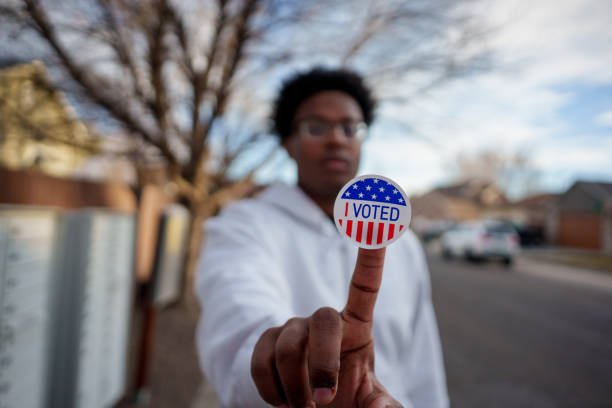
For years, Black men have been reduced to political talking points every election cycle.
Democrats assume they’ll show up. Republicans believe they can pull them away. Meanwhile, a new poll suggests many younger Black men are sitting somewhere in the middle with mounting frustration, skepticism, and still waiting to feel genuinely connected.
A new survey released by the organization Black Men Vote and conducted by HIT Strategies examined Black male voters ages 18 to 45 in six key states, including Michigan, Georgia, Pennsylvania, North Carolina, Mississippi, and South Carolina. The findings paint a more layered picture than the one that’s typically pushed about Black men’s voting habits in national political conversations.
Most young Black men still believe in voting. Ninety-two percent of respondents said voting is important. But many are no longer convinced that voting alone has materially improved their everyday lives, especially when it comes to economic opportunities, wages, housing, and long-term stability.
That tension is reflected in the turnout numbers. While 74% of respondents said they are likely to vote in the 2026 midterm elections, more than one in four surveyed said they are uncertain or unlikely to participate.
In battleground states like Michigan and Pennsylvania – where elections are routinely decided by narrow margins – the difference between wins and losses could rest entirely on the shoulders of Black men who sit out the elections after deciding that their votes won’t change their quality of life.
But researchers say the hesitation should not automatically be interpreted as apathy or political disengagement.
Instead, the poll points to something many Black organizers and community leaders have quietly acknowledged for years. Younger Black men often feel disconnected from political candidates, disconnected from the parties that consistently claim to represent their interests, and disconnected from the belief that the political process has produced meaningful economic change in their communities.
These frustrations are rooted in the lived experiences of rising housing costs, stagnant wages, limited access to capital, underemployment, and uneven investment in Black communities which continues shaping how younger Black men view politics. Symbolic representation and campaign rhetoric matters significantly to this voter bloc, but many voters are increasingly measuring political success through tangible outcomes tied to quality of life.
The poll found that while a majority of respondents still identify as Democrats, roughly 20% identify as Independents and another 20% identify as Republicans. Even then, researchers said traditional partisan labels fail to fully capture how many younger Black men see themselves politically.
“Black men are not politically absent, they are politically misread,” Michael Bland, executive director of Black Men Vote, said in a statement.
That misunderstanding has created a tendency to flatten Black male voters into the single narrative that they are either unquestioningly loyal Democrats or disaffected voters shifting sharply to the right. The poll shows, however, that neither of those are fully accurate.
Researchers found many respondents remain broadly left-of-center politically, even as they express skepticism toward both parties. Among conservative-leaning respondents, the largest ideological identity measured was “family values conservative,” not MAGA Republican.
That distinction is important, particularly in Michigan, where Black voter turnout has repeatedly shaped statewide and presidential elections. Detroit remains one of the Democratic Party’s most important political bases nationally, but younger Black voters increasingly expect more than election-year outreach and symbolic messaging, which led to an underwhelming level of support in the 2024 general election.
Many are looking for policies tied directly to economic mobility, entrepreneurship, affordable housing, safer neighborhoods, and pathways to wealth creation. Without visible progress in those areas, some younger Black men are becoming less emotionally invested in the political process itself.
The survey also found that some Black men who supported Democratic candidates in 2024 are now uncertain whether they will participate in the 2026 midterms. Researchers described that dynamic as an “activation challenge” as much as a persuasion issue.
In other words, the challenge for Democrats goes beyond simply convincing Black men who to vote for. Democrats are now tasked with rebuilding trust among voters who no longer feel consistently prioritized once elections end.
The study also examined how younger Black men consume news and political information. Half of respondents described themselves as active news consumers, while another 44% said they primarily encounter news through social media feeds and digital platforms, which has been a growing trend for the last decade. Only 6% said they avoid news entirely.
YouTube emerged as a dominant source of political and cultural information. Ninety percent of respondents said they use the platform multiple times a week, and many identified it as a primary place they turn for political commentary, breaking news, and public discourse.
The findings reinforce how dramatically political communication has shifted. Civic engagement now competes alongside entertainment, sports, podcasts, music, gaming, memes, and influencer culture in the same digital spaces, whereas historically, that wasn’t always the case. Researchers found respondents were most likely to engage with content connected to humor, music, and culture, signaling that traditional political messaging often struggles to break through when it feels overly scripted or transactional.
The poll ultimately identified six distinct groups among younger Black male voters, ranging from highly engaged Democratic-aligned voters to politically alienated but civically active men, to disengaged voters with low participation likelihood. Together, the findings underscore that Black men are not a monolithic voting bloc and cannot be approached through a single political strategy.
What the research makes clear, however, is that younger Black men are still paying attention. They still value civic participation. But many are demanding that politics should feel more connected to their lived realities and less dependent on assumptions about automatic loyalty.
For both political parties, they can either take this data as a wake-up call to be more accountable to a swing group that feels disenfranchised, or they can continue with the status quo. The results from these upcoming high-stakes elections across the country will be proof in how seriously Black men’s concerns are considered by the politicians who desperately need their votes.
You must be logged in to post a comment Login