

Losing one child to gunfire can be shattering. Sometimes it’s just the start.
By Joe Sexton
The Trace
https://www.thetrace.org/
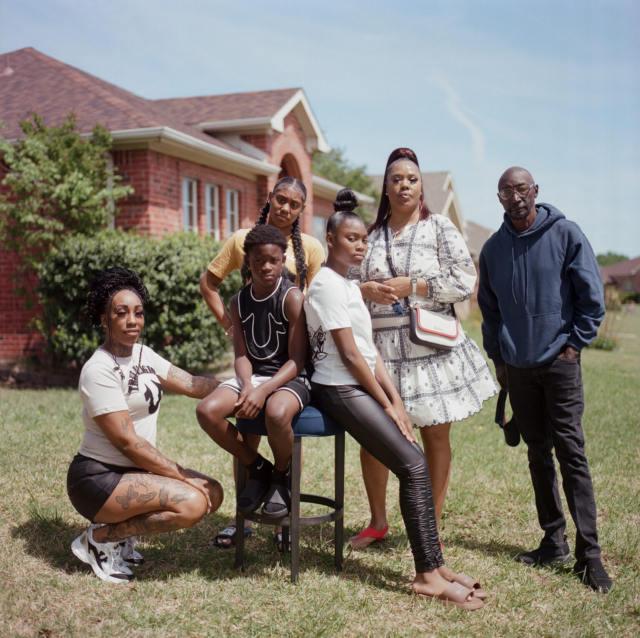
The naked body of her dead 14-year-old son lay in front of Brittney Ross at the Golden Gate Funeral Home, in South Dallas. The home had told Brittney that it would cost an additional $400 for its workers to dress her boy Ah’Bralen before his viewing. And so Brittney decided to do it herself. She’d brought an outfit that included a black-and-blue designer sweater, newly bought slacks, and a pair of Ray Ban sunglasses.
As she arranged the clothing, Brittney’s cellphone rang. It was a call from her house, likely one of her five other children. It could wait, surely. She did not pick up.
Ah’Bralen had been shot in the face at a friend’s house in Northeast Dallas days before. The bullet had exited the back of the boy’s head, leaving a gaping wound, but it had not killed him right away. Brittney had spent several days by her son’s hospital bedside, the blood from the wound soaking through each new set of bandages. Then she gave in to the inevitable, and asked that the machines keeping an unconscious Ah’Bralen alive be turned off.
Ah’Bralen’s death was one of the last of the 246 homicides recorded in Dallas in 2023, a total up 15 percent from the year before, and enough to rank the city — famous for its real estate and energy billionaires and the Cowboys of the National Football League — as the 13th bloodiest in the nation, per capita. At the time, the Dallas Police Department offered no concrete answers for the sharp uptick in violence. There was talk of increasing patrols, and pledges from local nonprofit organizations, some run by pastors and principals, at least one headed by a former Dallas gang member, to try harder to solve the root causes of the carnage. The young ages of those being killed, and those being charged with their murders, was of particular concern.


Ah’Bralen’s short life followed a familiar arc. He’d been a sweet boy with behavioral challenges, and a lazy eye that made him a magnet for bullying at school. His father was not a regular presence, locked up or off with a different woman and additional children. There might be the occasional visit, but there was never enough consistency to soften Ah’Bralen’s hurt and loneliness. Brittney and her children lived in a particularly rough corner of South Dallas during his early years, and Ah’Bralen sought to find a sense of belonging in, or at the edges of, one of the city’s gangs. The family had later left the neighborhood for the relative safety of a three-story place in Northeast Dallas, but trouble, whether it’s looking for you, or you are looking for it, knows few hard boundaries in the city.
Of the youngsters in South Dallas Brittney was hoping to separate her children from, she said, “I’m thinking I’m leaving these kids, and we’re running right back into them.”
And so Ah’Bralen fell behind at school, and, found to have taken a $1 bracelet from a classmate, he did a short stay in a juvenile detention residence. Eventually, he would climb out the windows of his home to be with his boys. He’d almost always call his mother to let her know where he was. “Just get home safe,” she’d say. There’d be months when Brittney succeeded in keeping him indoors, and out of harm’s way. She did her best to restrict who came into her house. But there are limits to what love, however strong and lasting, can do, or protect. In late December, then, Ah’Bralen pleaded with his mother to be let out. He talked of just wanting to go to a CVS store. A boy was waiting outside for him. “That boy’s going to get you hurt,” Brittney told her son. But she consented, and walked out into the street to see Ah’Bralen off.
Ah’Bralen would be gone for 36 hours, apparently holed up in the nearby home of his girlfriend. The place was a kind of free-for-all for teens who’d run off from their families, for a night or two, or maybe longer. Detectives reached Brittney with their grim call at 5 a.m. on December 29. There would be all sorts of competing accounts of what led a boy Ah’Bralen was with to fire the gun. A dispute. An accident. Both, maybe. In the end, Charles Benjamin Robinson was arrested and charged. He was 14.
Days later at the funeral home, Brittney, then 33, was a bit scared to be with her lost son, and to have to work out the mechanics of getting him dressed. She’d asked a friend to come be by her side. But, if frightening, putting on her boy’s clothes for the last time also felt right. The duty and privilege was hers, no one else’s. She began with Ah’Bralen’s socks and underwear.
Then her phone rang again. Maybe the children back home wanted her to bring food when she was done. Who knew? Her world had become a bruising blur. It was about to get worse, but for the moment, Brittney let the call roll to voicemail.

Brittney wasn’t sure she could handle one more baby when she became pregnant in 2017. She had three boys, including Ah’Bralen, and two girls, one beset with sickle cell anemia. While raising her kids, Brittney had almost always found a way to hold down a job — bookkeeping at a law firm, a gig at Macy’s, and another at a warehouse in Dallas. But it was exhausting, and the specter of danger in the city’s streets added to the daunting work for her and the children. She turned to her mother and step-father for counsel — and she got way more than that. Her parents offered to take the newborn in, and raise the child for as long as Brittney needed. When, months later, Brittney gave birth to a girl, Ah’Laynah, she went to live with them straight from the hospital
Andrea Modic, Brittney’s mother, had grown up in one of Dallas’s early public housing projects, and she’d had to do her own navigating of the city’s threats and informal curfews, its routes to simple survival, and its evident, if seemingly elusive opportunities for safety and success. Andrea had been a health care worker for much of her career, including years spent at a Dallas hospital.

Andrea described Brittney as bright and hard-headed, full of her own ideas and great confidence in their merits. “A little pistol,” she said. Good at school, Brittney wasn’t always great about getting there. She’d prove to have a taste for bad boys, and she’d ring up a few minor brushes with the law. At 16, she had her first child, Timothy. Andrea never wobbled in her faith and support for her daughter, and by a mix of luck and design, Andrea had come to have an extra set of hands in Michael Key.
Key, a son of rural Alabama, had led a journeyman’s life, in and out of school, on and off this or that job, involved with a series of women. His mother had died when he was 13, and he’d had to flee an alcoholic, abusive father. He’d go to Georgia, and back to Alabama, out to Texas, and back once more to his family’s home town of Sylacauga, 50 miles outside of Birmingham. There would be work farming peas and okra, stints in flour mills, and, despite never having gone past 12th grade, a run as a computer tech for one of the wealthiest men in Dallas.
And there would be children — his first in Sylacauga, three during an initial stay in Dallas, eight in all by the time he’d nailed down a career as a bus driver for Dallas Area Rapid Transit and befriended Andrea Ross, a woman almost 10 years his junior. Michael, 64, never forsook his bounty of children. He sent money and tried to stay in touch. One made her way to Dartmouth College. He was not very present, though far from a perfect dad. His shortcomings gnawed at him.
Michael had been with Andrea for close to 20 years. He’d helped as best he could during Brittney’s teen years. He’d taught her how to drive. He’d smiled at that and other triumphs, and been steadfast during her episodes of acting out. And he’d been a reliable grandad to Brittney’s first five children.

But when Ah’Laynah arrived at his home, Michael felt a rare bond take hold. He and Andrea nicknamed her Baby Girl, and Michael got himself up at 3:30 a.m. each morning to warm milk for her bottle. Michael later spoiled her as best he could on a civil servant’s salary: trips to McDonald’s, modest shopping sprees at Target. He liked to joke that Ah’Laynah could operate a smart phone at 6 months. Andrea and Michael put copies of her day care and pre-school certificates throughout their apartment in the John West Road section of East Dallas.
Ah’Laynah was almost 3 before Brittney asked to have her back. It was a sensitive proposition. The child was thriving. Brittney, whatever her strengths, was in the thick of keeping her three boys alive. The challenge was real: A friend of her oldest child, Tim, had been shot dead. And Tim himself had spent time in the city’s juvenile justice system after being found with an illegal firearm. Ah’Bralen, meanwhile, had begun his drift toward danger, too.
In the end, though, the question of Ah’Laynah’s future was not a negotiation. Brittney stopped asking, and instead demanded her back. Ah’Laynah started spending weekends with her mom and siblings. But soon, with Ah’Laynah turning 3, the transfer was complete. For Andrea and Michael, truth be told, the handoff happened with an everlasting whiff of worry.
Over the last two decades, a variety of news organizations across the country have responded to the plague of gun violence by chronicling every homicide in their city in a calendar year, an effort to both emphasize the scope of the casualties and to show the nature of the lives cut short. The Los Angeles Times was one of the first to do it. In 2024, The Dallas Morning News became the most recent.
The project, titled “Life and Loss,” didn’t have to wait long to log its first entry: Carlos Roque Jr., 21, fatally shot on January 1, 2024, in the 3500 block of Ross Avenue in Old East Dallas. The entry noted that Roque was the older, devoted brother to two siblings. “He loved kids,” his mother said. “He never got to have any.”
Families Transported to A World of Hurt
- Brooklyn, New YorkIn the 1990s, Frances Davis lost three sons, Raleak, Andrew and Frankie, to gun violence. She later saw two of her nephews killed in a Brooklyn shooting as well.
- Birmingham, AlabamaIn 2018, Demetrius Antwan Davis Sr. was shot to death outside a grocery store on the city’s West Side. Nearly five years later, his 25-year-old son, named for him, was murdered as well, shot dead in an ambush outside a Circle K gas station on Tallapoosa Street.
- Nashville, TennesseeIn 2025, 26-year-old Dana Corley was killed in an apparent robbery. It came a decade after his father, Dana Mayo, had perished, shot to death in his car on a Nashville street.
- Avondale, ArizonaIn 2023, Re’Mijae Thompson and her brother Tremuir, both 16, were killed months apart.
- New Haven, ConnecticutIn 2020, LaQuvia Jones lost her youngest son Dashown Myers when he was 18. Less than three years later, her other son, 23-year-old son Dontae Myers, became the city’s first homicide victim of 2023 when he was fatally shot Sunday afternoon in New Haven.
- Washington, D.C.In 2018, Seditra Brown lost a son, Paris, found dead on a city sidewalk. By 2021, she’d lost two more sons, Kalif and Montray.
- Atlanta, GeorgiaIn 2017, Belinda Oliver’s 18-year-old son, Markeith Oliver, was shot and killed while selling water bottles outside a southwest Atlanta gas station. Five years later, her youngest, Kelvice, 15, was gunned down as well.
- Fulton County, GeorgiaIn 2021, 5-year-old Khalis Eberhart was accidentally shot and killed by her 3-year-old cousin. Later that year, the girl’s cousin, 11-year-old Elyjah Munson, was shot and killed by a 12-year-old friend during an argument.
- Chicago, IllinoisIn 2020, LaTanya Gordon’s 20-year-old son Tyler was killed on the city’s streets. Three months later, she was burying his brother Terrance, 15.
- Indianapolis, IndianaIn 2025, Xavion Jackson, 16, was killed in a mass shooting. He was the third of Xiyya Jackson’s sons to lose their life to gun violence.
- Concord, North CarolinaIn 2020, two cousins, 13-year-old Avenanna Propst and 31-year-old Derron Jordan, were shot and killed over the same weekend.
- Omaha, NebraskaIn 2023, 16-year-old Lamarantae Swift, and her 19-year-old cousin Dontayzhia Swift, were slain three days apart.
- Bronx, New YorkIn 2025, Darrell Harris, 17, was fatally shot during an argument over a water gun fight that broke out in a Bronx park. Harris was Kellie Lewis’s second son to be lost to gunfire. Her older son, Jamal W. Hunter, was killed in the Morrisania neighborhood of the Bronx in 2021.
- Philadelphia, PennsylvaniaIn 2017, when Kahlief Myrick was in the seventh grade, his uncle Kamal Myrick, was gunned down about a block from Kahlief’s house. Four years later, Kahlief died by gunfire, becoming at least the 50th student at South Philadelphia High School to lose their life to violence.
- Rochester, New YorkIn October 2020, Titiana Bogar’s son Lysaun Curry, 18, was shot and killed. Three years later, her son Anthony Miller-Curry, 19, was gone, too, when a pair of shootings left two dead, and three others injured.
- Queens, New YorkIn 2015, NeShawn Plummer, 16, was shot and killed just blocks from where his brother Shawn had been slain two years earlier.
- Brandon, MississippiIn 2024, Cameron Horne-Crook, 14, was gunned down March 25. By April, his brother, Bryson Horne-Wash, 20, had also been fatally shot.
Roque, it turned out, was one of three people killed in Dallas that first day of 2024. Plenty more followed — a 29-year-old two days later, a 25-year-old the day after that. Dallas closed out the last week of January with a run of eight murders. The data collected and sorted by the Morning News showed that 90 percent of those killed had died by gunfire, that just 7 percent of those killed were white, and that close to 83 percent were men or boys.
Explaining what exactly drives murder rates in America has long been a tricky proposition. New York City, for instance, has cut its homicides from more than 2,000 a year in the early 1990s to roughly 300 in 2025. What fully accounted for that drop, though, has provoked debate and dispute at every step of the decline. The end of the crack epidemic. Data driven policing. More sophisticated community efforts to identify and assist young people on society’s margins. Mass incarceration. The gentrification of vast swaths of the city. The potential determinants of killings in American cities — subject to political spin and tending to shift from year to year — are many.
In Dallas, it’s been no different. Surprising decreases have been followed by alarming surges. Police chiefs and their strategies and task forces have come and gone. But five years ago, Eddie Garcia, then a candidate to be the next police chief, teamed up with a handful of researchers to develop a formal strategic plan for reducing violent crime. One of those Garcia tapped was Michael R. Smith, a professor of criminology and criminal justice at the University of Texas at San Antonio.
In an interview, Smith, with a rueful chuckle, acknowledged the challenge of decoding the rises and falls of crime rates, including homicides. “I’m one of the experts, and I don’t have a great explanation for it all, if I’m being honest,” Smith said.
When Garcia got the job as the top cop, thereby becoming the first Latino to head the Dallas Police Department, he and Smith realized they’d now have to put their ideas into action. They called it the Dallas Crime Plan, and it was built around three central pillars. The first was to use crime data to identify “hot spots” across the city, and target them with man power. It was a proven idea implemented in other cities. Its effects, though, Smith said, would be limited — like taking Tylenol to reduce a fever, while not treating the underlying illness.
The plan’s second initiative was meant to better understand what Garcia and Smith called the city’s “physical networks” of criminal activity –— how one apartment complex, say, was working in tandem with the city blocks surrounding some nearby gas station — as an additional way to draw up productive investigations and interventions.
And last, there was to be an effort to identify the city’s most violent repeat offenders, give them a formal score reflecting the future threat they represented, and to then meet with them in person. The repeat offenders would be offered one of two ways forward: They could become the targets of concentrated and aggressive prosecution seeking maximum penalties, including federal charges often related to the use of guns in their crimes, or they could agree to accept meaningful assistance from the city with things like job training or drug treatment. In short, they could give up their lives of crime, or risk paying for them more severely.
City leaders were excited. Annual budgets of $8 million were committed. Garcia promised that meaningful metrics would be vigilantly tracked and made public, whether encouraging or not. There was, though, one result Garcia and Smith knew would be hardest to produce: driving down violent crime among young people. Maybe Dallas would get lucky. Maybe some of the tactics would have an effect. But the strategy of identifying repeat violent juvenile offenders and intervening to change them or lock them up for ages would be problematic in Dallas. State and local statutes kept the complete criminal histories of minors secret — both from researchers, and from the police and prosecutors, as well.
Juvenile gun deaths did indeed remain resistant to the Dallas Crime Plan’s early years of implementation. Minors killed by guns helped boost the overall increase in murders in 2023, and they would account for roughly 20 percent of 2024’s total. The reporting project by the Morning News at least gave them names and faces. Julian Zavala, 14, who wanted to be a barber like his dad, or maybe a trucker like his grandpa. Zayvyon Jones, 17, and Tonya Medina, 18, slain on June 3. Ten months into 2024, 25 Dallas youngsters had been killed.
There was one 2024 homicide, though, that the paper’s “Life and Loss” project did not take note of: the death of a 6-year-old girl killed by a single shot to the head in the early days of 2024. The reporter behind the project said no one had been charged in the death. The tragedy, she said, had been declared “unexplained” or “accidental.” The paper made the choice not to include the child’s death as a 2024 homicide.
Journalists and, increasingly, researchers have tried to get their arms around gun violence in America: the demographics of the dead, and those charged in their killings; upticks and downturns; weapons used, and how they were obtained; the dollars pumped into the protection of the weapons industry as it flooded the market with ever-more efficient killing instruments. There is not, however, much specific data on instances of gun deaths occurring in the same family.
That said, the anecdotes are not hard to come by.
Shirley Chambers said the reporters left years ago. The television news cameras, too. No one is knocking on her door to see how a mother feels after losing a child, and then another, to gun violence in Chicago.
“But I’m still here,” Chambers, 66, said. “And the pain is still here.”
Chambers was one of 13 children born into a family in Calhoun County, Mississippi. Her mother would eventually take her and 11 of the other children to Chicago in search of work and a brighter future. Her mother wound up going back to Mississippi, but Chambers was in Chicago to stay. She’d wind up an early resident at Chicago’s Cabrini-Green housing project. Built in 1942 as an integrated, pioneering development in the nation’s push to create affordable, even free housing for the working poor, Cabrini-Green would at its zenith hold some 15,000 residents.
Half a century later, Cabrini-Green was another kind of model — an archetype of the failure of public housing, portrayed by the political left as a neglected and abandoned ideal, and seen by the right as the logical and lawless consequence of what the poor, which largely meant people of color by the 1990s, did with public assistance.
Gangs fired semiautomatic weapons to ring in the New Year; fencing was built on the complex’s balconies, all but caging residents in like a prison; empty apartments were boarded up rather than rented anew. At one low point, Chicago Mayor Jane Byrne moved into an apartment in a bid to draw attention to Cabrini-Green’s dire state; in 1997, a 9-year-old child who would come to be known as “Girl X,” was raped and poisoned in the complex, left blind and paralyzed, a marker used to write gang signs on her belly.
In the late 1990s, in what many saw as an act of surrender dressed up by politicians and developers as a new way forward, the teardown of Cabrini-Green began. By 2011, the last vestiges of it would be gone altogether.
Shirley Chambers was there for all of it. She’d spent 26 years working for a famous Chicago hot dog chain, and many of those working years she was also trying to keep her three boys and a girl safe and on track.
In 1995, one son, Carlos, 18 and about to graduate from high school, was fatally shot in the back of the head by a classmate. Five years later, Chambers’s 15-year-old daughter LaToya was shot dead by a 13-year-old boy who’d been aiming for someone else. In a recent interview, Chambers described her daughter as “everything I could have wanted,” and said her loss left a hole in her heart that has never to this day been filled.
That hole was only going to get bigger, for misery was not yet done with Shirley Chambers. Not by a lot. Jerome, 23, was her next boy killed, shot at a public pay phone.
The killing of her last remaining child, Ronnie, occurred in 2013. Ronnie was said to have given up the gang life, and to be starting a career in music. He’d appeared on Ricki Lake’s television show as an example of constructive redemption. Then he was shot dead at 2:30 in the morning as he sat in his parked car on South Mozart Street. Some 500 people filled the pews of St. Luke Church of God in Christ for the funeral of the 33-year-old.
Today, Chambers lives in the suburbs of Chicago. She has a life partner she cherishes and leans on. She looks back on her repeated heartbreak with bewilderment and strength. She is thankful for each and every one of her lost children. “I’m proud to be their mother,” she said. Her advice to mothers who lose a child, or children, to gun violence, is to always keep them in your heart. That way, they will never really have left you, she said. Believe that you did the best you could, she said, and understand that the reasons they were taken may in this life be unknowable.
Chambers believes in Jesus Christ, and somehow, despite losing every single one of her children to gun violence, she still trusts in Christ’s example of suffering with dignity and faith. “If Jesus went through what he went through, I can survive, too,” she said. “I’m still here.”
At the Golden Gate Funeral home during the early afternoon of January 10, 2024, Brittney Ross was trying to slip Ah’Bralen’s shoulder into his shirt. When her phone rang a third time, she asked the friend who had come with her to pick it up.
Hours before, Brittney and her children had been at home, reeling from Ah’Bralen’s death, and the arrest of the 14 year-old boy charged with the killing. Detectives had yet to put together a detailed narrative of how and why it happened. And so there was a fear in the household, however inchoate, that Ah’Bralen might have been targeted, and that Tim, at 18 Brittney’s oldest child, or perhaps someone else in the family, was still at risk.
A friend of Tim’s had shown up at the house that morning, just before Brittney left for the funeral home. Tim said the young man could provide some protection. Brittney had just seen her son killed by someone he thought was his friend. She wasn’t inclined to trust some friend of Tim’s. But she was rushing to get to Ah’Bralen, and so, she recalled, “I put it in the hands of God.”

Hours later, as she dressed Ah’Bralen at the funeral home, it was Brittney’s daughter Ah’Zirah on the phone. Baby Girl had been shot.
Brittney has no clear memory of what happened next. She thinks she raced around the funeral home, crying and screaming, not knowing where to go or what to do or whom she might try to hug. Her friend drove her home, and she arrived to see her house cordoned off by crime scene tape, and her children in squad cars. Baby Girl was gone, transported to the hospital, Parkland Memorial, the modern day version of the facility where President John F. Kennedy was pronounced dead in 1963.
Once at the hospital, Brittney said she was told she could see Ah’Laynah, but that she could not touch her body. Her youngest child, only 6, the one she’d willingly given up and then later demanded back, had been shot once in the right side of her head. There would be no bedside vigil as there had been with Ah’Bralen.
Brittney remembers thinking that Ah’Bralen’s death was, if shattering, comprehensible in the dark calculus of the Dallas streets. Boys and guns and bravado and recklessness, even meanness. But Ah’Laynah was a girl, and a homebody. She’d been found in a room on the third floor where she played with her dolls. Nothing about her dying there was comprehensible.

In an interview, a detective who worked the case laid out what he believed happened: There had been at least two guns in the house. One might have belonged to someone in the Ross family, he said. But another gun had been brought into the home the day before by Tim’s friend, a 19-year-old named Damariya Sowels, and left there. That was the gun that had been used in Ah’Laynah’s death.
Brittney immediately suspected Sowels had shot her child, willfully or accidentally. But the detective said the young man had been on his phone on a recorded call with a friend in jail when the gun went off. When the detective listened to the recorded call, it was clear to him Sowels was not close to the scene of Ah’Laynah’s death. Both guns had been put in a bag, and hidden in a nearby garage. The detective said Brittney’s children had all changed into new clothes by the time officers responded.
When the boys in the house at the time of the shooting were tested for gun residue on their hands and body, all but Brittney’s daughter Ah’Zariah, confined to bed or a chair by her sickle cell disease, came up positive. The results, the detective said, suggested everyone had handled the gun at some point after it had been fired. The greatest amount of residue, though, was found on Brittney’s 8-year-old son, known as Junior. The detective said the young boy’s account had shifted during multiple interviews.
The detective said he had a frank conversation with Brittney. The evidence pointed to Junior having caused Ah’Lanah’s death. However, in Texas, children under the age of 10 cannot be criminally charged, the detective told Brittney. He said Brittney never agreed with the idea Junior was responsible. But she also did not argue that he was not. No formal finding of responsibility was ever produced, the detective said. The only person criminally charged in the case was Damariya Sowels, who was jailed for tampering with evidence.

Brittney said she had confronted Tim’s friend on the phone when she was racing back home that afternoon. “Just say who did it,” she told him. “If Junior did it, say it. Save yourself.” Brittney said the friend said nothing other than he had not shot her youngest child.
Brittney also disputed parts of the detective’s account. She said no one had tested positive for gun residue. The fact that Tim’s friend had been on the phone with someone in jail deepened her suspicion that he had a role in her daughter’s death. She said Tim had told her that Junior had never been on the third floor around the time of the shooting.
What was painfully clear was that Brittney now had to bury two of her children.

A week after Ah’Laynah’s death, then, an open white casket sat at the base of the platform deep inside the Inspiring Body of Christ Church. It was big enough to hold both children. Ah’Bralen had his sunglasses on, his hands folded in front of him. Ah’Laynah, lying to his left, was dressed in pink, her hair pulled back neatly, her face shining with closed-eyed innocence.
Brittney and her four surviving children wore memorial shirts bearing images of the two who had died. Several pews were filled with extended family members, many of them in the memorial shirts, as well. The funeral home’s online memorial page, built first just for Ah’Bralen, then expanded to include tributes to Ah’Laynah, included pictures of the children — on playgrounds, and in an inflatable backyard pool, sleeping four to a bed, and posing in matching Christmas outfits. There was also an image of Ah’Laynah’s certificate of achievement at the local Reading Academy. “Goal Getter,” it read.
The page drew condolences from Ah’Bralen’s boyhood friends. “I want you to know we feel the hurt. Just come back,” one read. There were notes from strangers, as well. “A beautiful little girl lost to a senseless act,” one said. “I don’t know you, but I love you, and I’m praying for you.” The page’s soundtrack was the spiritual, “Take Me to the King:”
Take me to the King
I don’t have much to bring
My heart’s torn in pieces
It’s my offering.
The Reverend Rickie Rush, pastor at Inspiring Body of Christ, noted the attendance of administrators from the schools the children had gone to, as well as representatives from the Dallas Independent School District. At one point, he called a family member up, and allowed her to play into the microphone a final recorded message from Ah’Bralen’s father, who was incarcerated.
Rush soon preached from scripture, and attempted to answer the question of God’s mercy. Where was He when these children were killed? “He was right where He was when his son was killed,” Rush said. A murmur of understanding pulsed through the pews.
Rush called Brittney to the casket. He invited her to kiss both children, and she did.
“Say good night,” Rush said to Brittney as he closed the casket.
There was at least one source of light in the Ross family in the aftermath of all the hurt. Tim, Brittney’s oldest, had his own baby girl, Khemistry, not yet a year old at the time of Ah’Bralen’s and Ah’Laynah’s deaths. Tim had known the girl’s mother, Drenesia Willis, at least since middle school.
Tim ran track in school, and made the seventh-grade football team without ever having played the game before. “I felt like I was a star,” he said. His arrival as a father at age 18, however, came after his own ragged journey through adolescence. Time in juvenile hall, marijuana use, and an intimate appreciation of the menace of guns — his friend John, 20, was killed one Fourth of July. He does not blame Dallas as the source of his challenges; hanging with the wrong people was his issue.
Michael Key, Tim’s step-grandfather, had implored the boy to wake up and walk straight before it was too late. Michael had seen his next door neighbor shot to death by a 16-year-old. Another man in his apartment complex had killed his wife and two children, 13 and 16, in 2020. Dallas could be an explosively mean place.
The birth of Khemistry would add a new set of opportunities and challenges. “We had an adult life,” Tim said, “before it was even our time.” It took just a couple of months for disaster to strike. Again.
In a burst of gunfire one April day in 2024, Tim was shot in the leg in the streets of South Dallas. “Wrong place, wrong time, nothing too major,” he said. It was enough, though, to require him to be taken to the hospital, and once there, he’d wind up arrested himself for an old violation related to possession of a gun and marijuana. It was possible that now, an adult, Tim would be looking at a significant sentence.
As he awaited his fate in jail, Tim placed a call to Brittney. She was crying when she picked up. Tim first thought she was upset because she’d talked to his lawyer, maybe learned he was looking at hard time. Then she told him: his baby’s mother, Drenesia, 17, had been shot and killed, along with her mother, Tim’s baby’s grandmother.
The police account was that Drenesia had fought with a woman in their apartment complex in South Dallas, and after the woman had been taken into a neighbor’s place, Drenesia and her mother, 40-year-old Laneshaia Pinkard, had shown up, perhaps to confront the woman again. The neighbor, 65-year-old Doris Walker, shot Drenesia’s mother first, then Drenesia as she tried to flee. Walker said she feared Drenesia’s mother had a gun, but none was ever found.
Both mother and daughter made briefly noted appearances in the 2024 “Life and Loss” project in the Morning News. “A bright light,” set to graduate high school, the posting said of Drenesia. Laneshaia had a second child, now without a mother or sister. “Heaven has really gained a beautiful angel,” her posting read.
In an interview, Tim offered his own appreciation of his child’s dead mother: “I never met a female so genuine.”
In 2025, Dallas saw a second straight year of declines in its murder rate. The 141 killings represented a 27 percent drop from 2024’s total, and amounted to the fewest the city had seen in a decade.
Eddie Garcia, the police chief who had implemented the Dallas Crime Plan, has moved on, and is now the top cop in Fort Worth. Mike Smith, the professor who had helped Garcia conceive the crime reduction strategy, is still tracking the plan’s impact, but he said it was too early to fully tease out the possible forces at work behind the decline. He did say the “hot spots” policing tactic — the “fever reduction” aspect of the crime plan — was understood to be paying dividends.
The decline in Dallas killings is consistent with broad and quite dramatic national trends. The country’s murder rate in 2025 fell by slightly more than 20 percent, the biggest single-year decline on record — this just five years removed from major increases during the COVID pandemic and the national unrest after the murder of George Floyd in Minneapolis. At least 27 American cities in 2025 recorded murder rates lower than they were before the pandemic. Baltimore, Maryland, and Chattanooga, Tennessee, were just two of them.
For all the good, if not yet fully explained developments, 2025 was still a bloody year in the U.S. Thirteen million guns sold; more than 400 mass shootings; over 100 people on average shot every day of every week of every month; a record 2,000 suicides by firearm per month; 1,200 children killed by gunfire.
In this post-pandemic era of violence, American children continue to be ensnared in gun crime even as their hometowns become safer. For example, Detroit recorded fewer than 200 homicides in 2025, the city’s lowest number in six decades. But during the same year Detroit also saw a 33 percent spike in juvenile victims of shootings, along with an 18 percent increase in the number of young people caught with firearms. Last summer, Detroit endured a nine-day spate of violence that left more than a dozen young people dead or injured, a grim reminder of how youth violence can persist against a backdrop of overall improvement.
In Dallas, the drop in juvenile homicides in 2025 was only half as significant as the city’s overall decline. Seven months into 2025, the latest figures available showed 18 youngsters had been slain. One was a 15-year-old boy found shot to death at 1:50 a.m. at a gas station on East Overton Road in April. The child’s name was Charles Benjamin Robinson, and he was the boy charged in Ah’Bralen’s killing. He’d been charged as a juvenile, and released a little more than a year later with an ankle monitor. Another young person, this one 18, was charged with Robinson’s murder.

It is the country’s mothers who have more often than not shouldered the peril and pain of children caught up in, or innocently swept away by, the seemingly endless gun violence in their communities. They spend years trying to keep their boys and girls safe, and lifetimes mourning their absence when they are taken. The burden has prompted a radical response from a striking number of women, some who have suffered loss, others who every day dread they might tomorrow: These women are leaving the U.S. altogether. In January, Jessica Grose spoke with some of those women for The New York Times. “For a variety of reasons,” Grose wrote, “they described the feeling that violence was closing in on them.”
Brittney Ross knows the feeling. Even if she wanted to, fleeing America was not a realistic option, but Brittney has made it as far as Mesquite, Texas, a city of 75,000 on the southeast outskirts of Dallas. She moved there to put some distance between her family and Dallas, and their heartbreaking run of losses there. Junior is with her, as are Tim and his child, Khemistry. “She’s 3, and getting smarter every day,” Brittney said of her granddaughter.
The move has not guaranteed the family is out of harm’s way. Last October, an 18-year-old graduate of Mesquite High School was shot and killed on the grounds of Junior’s grade school, just a couple of blocks away from home.
Sorrow stalks Brittney, and despair can drop on her like a heavy blanket. She has lost two children, almost lost a third when Tim was shot, and now has a granddaughter who will never know her mother or her mother’s mother. But for now, she tries to reassure herself that those she has left are enough.
“I battle with myself every day to pull myself together,” Brittney said. “And then I just look at my kids. I mean, if I give up or do something crazy, then who do they have to follow on?”
Ava Sasani contributed reporting to this story.







You must be logged in to post a comment Login