

Listening to Black women’s experiences and perspectives is essential to addressing racial health disparities, advancing equitable care and building a system that serves everyone.
By Lauren E. McCullough PhD
Essence
https://www.essence.com/
Life often takes us down unexpected paths. For me, a personal tragedy shaped my journey toward becoming a cancer epidemiologist. While I was still a college student, my father was diagnosed with lung cancer at 50 years old and died of the disease just months later.
Watching my dad navigate the health care system raised questions that my pre-med coursework couldn’t answer. His distrust of the system was rooted in his experiences as a Black man traversing a health care field that often failed to serve him. His life—and his loss—helped set me on this path, one that I now know God had already designed for my life. After graduating college, I changed my professional focus and eventually earned a Ph.D. in epidemiology, centering my work on understanding and addressing cancer disparities, particularly among Black women.
Black Women and Breast Cancer
As we observe Breast Cancer Awareness Month throughout October, it’s important to recognize that the disease is now the leading cause of cancer death among Black women in the United States, surpassing lung cancer in 2019. Although earlier detection and improved treatment are resulting in a steady, decades-long decrease in breast cancer death rates, Black women are still 37% more likely to die of breast cancer than White women, and twice as likely to die of the disease before age 50. Black women also experience disproportionately high rates of triple-negative breast cancer, an aggressive subtype with fewer targeted treatment options.
One goal of Breast Cancer Awareness Month is to highlight the importance of regular screenings and other opportunities to reduce cancer risk, including physical activity, a healthy diet and avoiding alcohol and tobacco. Yet, the health experiences of Black women are shaped by factors that extend well beyond individual behaviors. Even when accounting for factors such as health insurance and household income, racial differences in outcomes persist. This tells us that we need to look beyond individual-level factors to understand what is driving these disparities.
How the VOICES Study Breaks Ground
The key to understanding why these disparities persist is to examine factors that have historically been missing from cancer research, such as health care discrimination and bias, generational wealth and privilege, caregiving and family responsibilities, social and community connections, and neighborhood conditions.

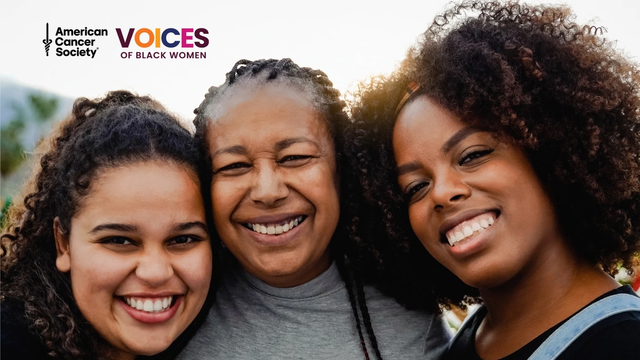
That’s the goal of the American Cancer Society’s VOICES of Black Women®, a study designed and led by Black women to better understand and improve the health of women of color across the United States. I’m one of the lead investigators of the study, which is built to follow 100,000 Black women between ages 20 and 60 to provide a large-scale, long-term picture of our health and the factors that shape it over time.
VOICES is unique in this space. It is a Black women-led study, with Black women representing more than 80% of the study team and holding key scientific and operational leadership roles. Our Scientific Advisory Board is also composed entirely of Black women with cross-disciplinary expertise in Black women’s health. That leadership is reflected in how we approach the science: VOICES studies Black women on our own terms rather than positioning White women as the benchmark for comparison.
Being Part of the Solution
As a mother of three, I know what it’s like to balance competing responsibilities. Yet, Black women shouldn’t view VOICES as just one more thing to add to the list. Participation is an opportunity to make our experiences part of the scientific record and to contribute to research designed specifically around our health. This is about community. Each woman brings her own experiences, but together those experiences can help us answer questions that no single data point can answer alone.
Enrollment is simple and designed to fit into women’s lives. It can easily be done online at voices.cancer.org. Participants take an initial one-hour survey, then do twice-yearly check-ins that take about 30 minutes apiece. Even with so many competing commitments, an hour a year can help build a body of knowledge about Black women’s health that could be the key to unlocking new discoveries and opportunities to prevent and survive cancer—knowledge that can inform how we improve health for our families and communities.
As Black women, I think we sometimes prioritize others’ needs and put our own further down the list. But our needs are equally important, and this study is one way to make sure our health and our experiences are represented in the research that shapes what comes next.
This month, I hope more Black women will choose to make their experiences count. Visit voices.cancer.org to learn more and join us.
Lauren E. McCullough, Ph.D., MSPH, is senior scientific director of epidemiology research at the American Cancer Society, a leading cancer-fighting organization with a vision to end cancer as we know it, for everyone.


You must be logged in to post a comment Login