

The city’s racial equity plan is on hiatus. City leaders say they’ll focus on small businesses when awarding contracts.
By Everton Bailey Jr.
Dallas City Hall Reporter
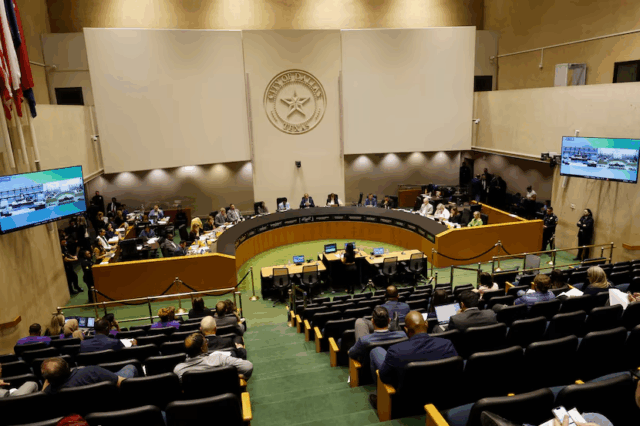
Chitose Suzuki / Staff Photographer
The city of Dallas has stopped all policies and programs designed to promote diversity, equity and inclusion.
City leaders say they are pausing the programs for review in an effort to comply with anti-DEI directives recently announced by President Donald Trump and retain millions in federal grant funding. The move puts the city’s Office of Equity and Inclusion and other programs at risk.
City Manager Kimberly Bizor Tolbert said Wednesday she also ordered every city department to stop using policies and programs that consider race, gender, ethnicity, religion or national origin in decisions regarding the allocation of funds or benefits.
The instruction came the day after a June 25 City Council vote authorizing Tolbert to review and evaluate all city programs for compliance with federal directives and temporarily pause those that don’t comply.
“Compliance ensures that we are accountable, transparent and eligible for the resources that we know our community deserves,” Tolbert told the Dallas City Council during a briefing meeting on Wednesday.
The Fort Worth City Council on Tuesday also agreed to suspend DEI initiatives to comply with Trump’s executive orders.
Tolbert said the city of Dallas created an internal compliance group to help assess and legally review city initiatives. That group is expected to issue recommendations for additional policy and program changes to the City Council on Sept. 24.
As a result of the review, the city stopped following its racial equity plan, a strategy approved by the council in 2022 to address racial and ethnic disparities impacting Dallas residents.
The pause also affects a business inclusion and development policy aimed at helping businesses owned by women and people of color land city contracts.
Some of the programs could be revamped.
Juanita Ortiz, Dallas’ procurement services office director, said the city can focus on small businesses based in Dallas rather than requiring minority/woman business enterprise goals in city contracts.
Several council members said they want to make sure the city’s revised policies don’t undo any progress in aiding underserved residents, businesses, nonprofits and other groups and that the new rules are clearly communicated to the public.
“If the same handful of people are getting contracts over and over, that doesn’t help our city as a whole,” said council member Gay Donnell Willis, the city’s deputy mayor pro tem. “And so expanding opportunity and bringing more jobs, helping businesses grow spills out to retailers and grocers and services, and it really makes Dallas stronger.”
City leaders say Trump’s executive orders and updated federal grant rules ban recipients of federal funds from supporting programs that prioritize race, gender or national origin in ways that could violate anti-discrimination laws. The rules also restrict programs that could be seen as encouraging undocumented migration and prohibit the evaluation of competitive bids based on race, gender, national origin or religion.
Trump’s executive orders don’t force cities to stop equity-focused programs, but they do stop federal contract or grant recipients from supporting diversity, equity and inclusion programs, city officials say.
City financial officials in February said Dallas has received an average of $305 million annually in federal grants over the last three years. They include community development block grants, which are used to support city housing and economic development projects as well as the U.S. Department of Transportation, Bureau of Justice Assistance, and a Special Supplemental Nutrition Program for women, infants and children.
Caleb Roberts, executive director of environmental advocacy group Downwinders at Risk, said his organization was “extremely disappointed that the city of Dallas is placing its DEI initiatives on the chopping block.”
“We understand that this was initiated by the federal government and not the city of Dallas, but it also shows that the city views DEI programs as expendable,” he told The Dallas Morning News. “Would the city capitulate if the federal government repeated the same tactics for other services like police, fire, and other services?”
Tolbert said possible impacts to Dallas municipal government staffing wouldn’t be revealed until her draft of the upcoming city budget is released Friday. City officials didn’t immediately respond Wednesday to inquiries from The News on what the changes could mean to the city’s office of equity and inclusion.
The future of the office, originally created in 2018 as the office of equity and human rights to advance access and opportunities for underserved residents, wasn’t discussed during Wednesday’s meeting.
The office has several responsibilities. It investigates discrimination in housing, public accommodations and employment. It also oversees city initiatives related to the city’s racial equity plan and ensures compliance with the Americans with Disabilities Act. The office also coordinates city civilian boards the Veteran Affairs Commission and the Commission on Disabilities. The office this year has a $2.8 million budget and 19 positions.
The changes are also an about-face of a multiyear push in recent years for city policies, programs and budgets to factor in the impact of institutional racism.
The City Council in March 2021, for instance, unanimously passed a racial equity resolution, pledging that the city would show its commitment to the cause through equitable investment and future funding decisions for specific projects, inclusive practices and socially just policies.
“The city will continue to promote equity through all policies of the city and enhance educational efforts aimed at understanding, addressing, and dismantling racism and how it affects the delivery of human and social services, economic development and public safety,” the resolution reads in part.
Everton covers Dallas city government. He joined The Dallas Morning News in November 2020 after previously working for The Oregonian and The Associated Press in Hartford, Conn.
This story, originally published in The Dallas Morning News, is reprinted as part of a collaborative partnership between The Dallas Morning News and Texas Metro News. The partnership seeks to boost coverage of Dallas’ communities of color, particularly in southern Dallas.









You must be logged in to post a comment Login